
What is a natural number? Is one prime? Is Pluto a planet, a tomato a fruit, or a bird a fish? Such questions appear to concern objective properties, yet their answers often depend on something less obvious: the definitions we adopt. Throughout history, mathematics and science have revised their terminology, not necessarily because earlier definitions were false, but because different classifications serve different purposes. Beginning with the natural numbers, we explore definitions in arithmetic, astronomy, taxonomy, and botany. We then introduce Formal Concept Analysis, which studies concepts through objects, attributes, and the relationships between them. Finally, we consider how different descriptions may identify the same object, how one name may refer to different objects, and why questions about poorly specified abstract concepts can be difficult to answer. The central claim is not that everything is arbitrary, but that separating definitions from the properties of what they describe can make many apparent disputes considerably clearer.
Introduction
Mathematics is often praised for its precision. Unlike ordinary language, where words can be ambiguous and interpretations subjective, mathematical arguments are expected to make their assumptions explicit: given definitions and axioms, we ask whether a statement is provable or unprovable within the system under consideration. Even a claim that cannot be proved from the chosen axioms may tell us something important about their expressive or deductive limits. Precision, however, does not imply that everyone must begin with the same definitions.
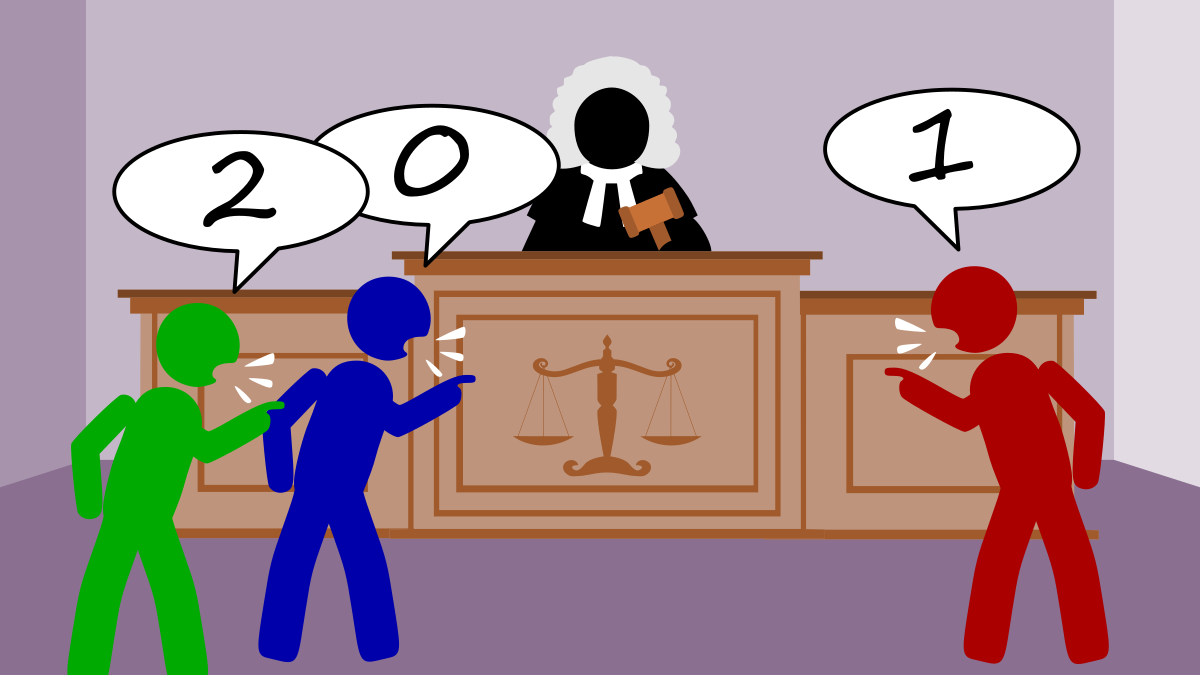
Consider a seemingly elementary question:
“Does the set of natural numbers contain zero?”
Ask a group of mathematicians, and you may receive different answers. Some will confidently declare that the natural numbers begin with zero, while others will insist that they begin with one. Both groups can appeal to established conventions, and both can find respectable textbooks supporting their position. Interestingly, in some educational systems students are taught to distinguish between natural numbers, beginning with one, and whole numbers, beginning with zero. This terminology may be unfamiliar to mathematicians educated elsewhere, even though everyone is studying essentially the same mathematics.
What makes the disagreement remarkable is that it does not arise from a difficult theorem, an unsolved problem, or an experimental observation. It arises from a definition. One might be tempted to dismiss the whole question as merely terminological: agree on what the symbol \(\mathbb N\) denotes, and move on. Yet it raises broader questions. Why do some conventions become widespread while others disappear? Does a new definition mean that an earlier generation was mistaken? And what does it actually mean to define something? The same questions will lead us from arithmetic to planets, biological species, mythical creatures, and even love.
What’s the first number?
Zero or one?
The familiar sequence \[1,2,3,4,5,\ldots\] has an intuitive interpretation: it describes counting. One apple, two apples, three apples, and so on. For this reason, beginning the natural numbers with one seems perfectly reasonable. Giuseppe Peano did precisely this in 1889 [14]. Modern presentations frequently take zero as the initial element instead [6], setting \[\mathbb N_0=\{0,1,2,3,\ldots\},\qquad \mathbb N_1=\{1,2,3,4,\ldots\}.\] Both conventions remain in use, so a careful author should state explicitly which is intended.
Including zero is natural in several mathematical constructions. Zero is the identity for addition; it is the cardinality of the empty set; and it is often a convenient initial value for recursion, indexing, and combinatorics. If cardinality measures how many elements a finite set contains, excluding the possibility of an empty set would be an unnecessary inconvenience. On the other hand, if one is studying positive counting numbers, starting with one is entirely reasonable. No theorem determines which of the two sets must receive the unqualified name natural numbers.
Why not two?
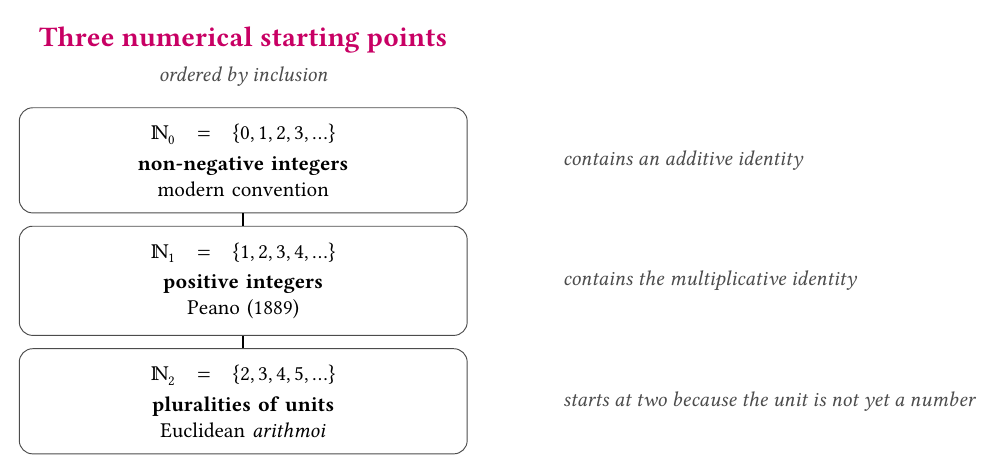
We could push the question further. If the natural numbers can begin with zero or one, why not two? Consider the sets \[\begin{aligned} \mathbb N_0&=\{0,1,2,3,\ldots\},\\ \mathbb N_1&=\{1,2,3,4,\ldots\},\\ \mathbb N_2&=\{2,3,4,5,\ldots\}. \end{aligned}\] All three are countably infinite and closed under the successor operation \(S(n)=n+1\). Considered merely as ordered sets, or as structures equipped only with successor, they are isomorphic: a shift \(n\mapsto n+1\) identifies one with the next and preserves the relevant structure.
They are not, however, interchangeable when equipped with the usual arithmetic operations inherited from the integers. For instance, \(\mathbb N_0\) has an additive identity, whereas \(\mathbb N_1\) does not. Both \(\mathbb N_0\) and \(\mathbb N_1\) contain the multiplicative identity \(1\), while \(\mathbb N_2\) does not. The shift is not an isomorphism of structures with ordinary addition and multiplication. Thus, depending on which operations and properties interest us, one of these sets may be more useful than the others.
This provides a first lesson: different definitions may select different structures, and their usefulness depends on which questions we want to investigate. We are perfectly free to define all three sets and give them separate names; nothing requires us to pretend that their algebraic differences are irrelevant. What would be difficult to justify is the assertion that a familiar name must, as a matter of mathematical truth, belong to exactly one of them.
The curious case of the number one
Another elementary question offers a related puzzle:
“Is one a prime number?”
An informal definition says that a prime is a positive integer divisible only by one and itself. Taken literally, this description seems to include \(1\), whose only positive divisor is \(1\). Yet modern mathematics excludes it.
A usual explanation invokes the Fundamental Theorem of Arithmetic: every integer greater than one is a product of primes, uniquely up to their order. Allowing \(1\) as a prime would produce meaningless variations such as \[6=2\cdot3=1\cdot2\cdot3=1\cdot1\cdot2\cdot3=\cdots.\] We could repair the theorem by continually appending the proviso that factors equal to one are disregarded. It is much more convenient to build the exclusion into the definition.
The modern algebraic language makes this explicit. In an integral domain, a prime element is a nonzero, non-invertible element \(p\) such that \[p\mid ab\quad\Longrightarrow\quad p\mid a\ \text{or}\ p\mid b.\] An irreducible element is a nonzero, non-invertible element which cannot be written as a product of two non-invertible elements. Every prime element is irreducible in an integral domain, but the converse need not hold; in the integers, the two notions coincide [5]. Here invertible means possessing a multiplicative inverse within the structure being considered. Among the natural numbers, whether we start with zero or one, the only invertible element under multiplication is \(1\): thus, for the natural numbers, the non-invertibility requirement excludes exactly the number one. In the ring of integers, both \(1\) and \(-1\) are units.
Did Euclid forget about one?
It is instructive to compare this approach with a much older one. In Book VII of the Elements, Euclid begins by defining a unit (μονάς, monás) and a number (ἀριθμός, arithmós) separately. A number is, in his terminology, a multitude (πλῆθος, plēthos) composed of units [8]. Consequently, the unit was not itself an ἀριθμός; the numbers, in this sense, began at two. When Euclid describes a prime number as one measured by a unit alone, the modern objection that \(1\) would be prime does not arise in the same way: the unit is not a number to be classified as prime.
This was not the only view in antiquity. The Stoic philosopher Chrysippos (Χρύσιππος) reportedly challenged the exclusion of unity from the numbers, treating one as a πλῆθος ἕν (a “multitude of one”). The proposal was controversial, not least because the expression itself seemed at odds with the ordinary understanding of plurality [12]. It is striking that a question which sometimes sounds like a modern dispute over notation was already entangled with philosophical disagreement about the nature of number.
From our perspective we can therefore distinguish three meaningful starting points: numbers as pluralities of units, beginning with two; positive integers, beginning with one; and nonnegative integers, beginning with zero. These are not literally the same conception, nor do they share every property once arithmetic operations are fixed. But selecting the ordinary name natural numbers for one particular set is a convention. Euclid and Peano were not wrong merely because they adopted different starting points.
A formalist perspective
The discussion leads naturally to philosophy. Are mathematical objects independently existing entities whose true properties we gradually discover, or should the emphasis be placed on the formal languages, axioms, and constructions through which we study them? Different philosophies of mathematics offer different answers. From the broadly formalist perspective adopted here, there is little reason to regard the starting point of \(\mathbb N\) as a dispute about a hidden numerical reality. What matters is that the objects and operations be specified clearly, so that their consequences can be investigated.
Jorge Luis Borges’s The Library of Babel offers a useful contrast: it imagines every possible book as already existing, independently of whether anyone writes or reads it. This presupposes a realist view of possible inscriptions, unlike the broadly formalist perspective considered here. Even in Borges’s Library, however, the existence of a text does not make its definitions true or useful, nor does it guarantee the existence of what they describe [3].
This does not make mathematics arbitrary. Freedom in choosing definitions should not be confused with freedom in deducing their consequences. Once we have fixed the relevant system, whether an argument establishes a claim is a matter of mathematical reasoning rather than personal preference. We may choose the rules of the game; we cannot simply choose what follows from them.
Pluto, tomatoes, and the problem of classification
Mathematics may seem special because its objects are abstract. Surely a physical planet remains a planet irrespective of how we choose to speak about it? The history of scientific classification suggests a more complicated picture: the bodies and their properties are there to be investigated, but the criteria by which we group them may change.
What is a planet?
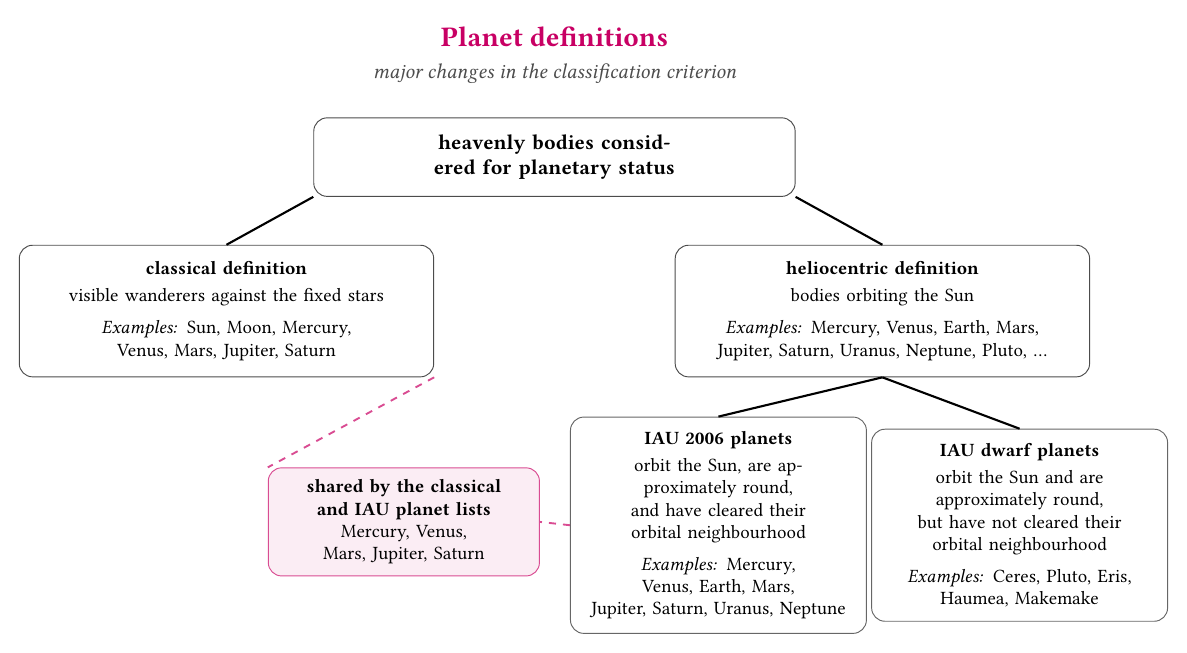
The word planet comes from the Greek πλανήτης (planētēs), a wanderer. In the Greek astronomical tradition, certain bright objects appeared to move against the backdrop of apparently fixed stars. The familiar seven wandering bodies were the Sun, the Moon, Mercury, Venus, Mars, Jupiter, and Saturn. Earth was not on the list. Although we focus here on the Greek terminology, related practices of distinguishing the wandering heavenly bodies from the fixed stars developed in civilisations across the world, notably in Mesopotamian, Indian, and other astronomical traditions; their categories and cosmologies were not necessarily identical [21, 7].
Heliocentric astronomy changed the arrangement. Earth came to be understood as a planet orbiting the Sun; the Sun was recognised as a star and the Moon as Earth’s satellite. Telescopic observation later brought Uranus and Neptune into the planetary family, while Pluto was discovered in 1930. Still more objects were identified beyond Neptune, and the discovery of Eris, comparable to Pluto in size, intensified a problem that could no longer be ignored: what exactly qualified as a planet?
In 2006 the International Astronomical Union adopted a definition specifically for Solar System planets. A planet must orbit the Sun, be massive enough for self-gravity to make it nearly round, and have cleared the neighbourhood around its orbit. Under this resolution, eight bodies qualify as planets, while Pluto is classified as a dwarf planet [11]. The decision did not alter Pluto’s mass, orbit, geology, or distance from Earth. It changed the criterion used to classify it. The new definition sought to distinguish dynamically dominant bodies from other objects, though the usefulness and scope of planetary definitions remain topics of discussion.
It is tempting to conclude that the earlier definition was simply wrong. But the older and newer schemes were answering somewhat different questions: one concerned the appearance and motion of heavenly bodies as observed from Earth; the other privileged orbital dynamics and physical characteristics. The change can reflect genuine scientific progress without making the old observational distinctions meaningless. The Sun is still visible in the daytime, and Neptune still is not visible to the unaided eye under ordinary conditions.
Are birds fish?
A similar issue arises in biological taxonomy. Traditional classifications frequently relied on morphology and familiar similarities: fish lived in water, birds possessed feathers, and mammals had hair and produced milk. With evolutionary theory and modern phylogenetic methods, researchers increasingly aim to classify organisms according to common ancestry, drawing on anatomical, fossil, and genetic evidence [4, 2].
This can produce surprising results. Birds are nested within the dinosaur lineage, and the lineage of tetrapods—including amphibians, reptiles, birds, and mammals—arose within the larger radiation of bony fishes. If Osteichthyes is understood as a monophyletic group containing an ancestor and all its descendants, it contains tetrapods. Thus a classification based on evolutionary ancestry can place organisms into groups very different from the categories suggested by their appearance or habitat. The word fish, moreover, is not invariably used as a formal taxonomic rank, and modern phylogenetic group names should not be confused with a single rigid hierarchy of Linnaean classes.
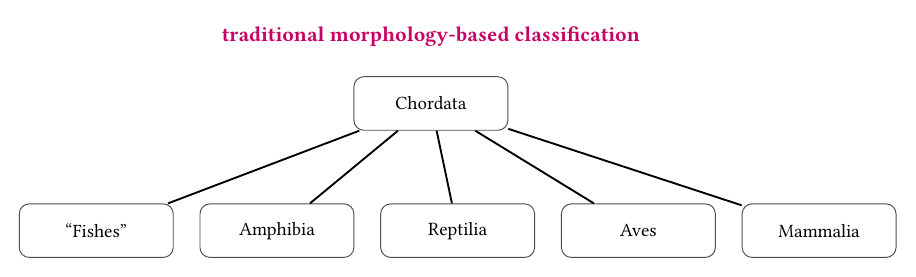
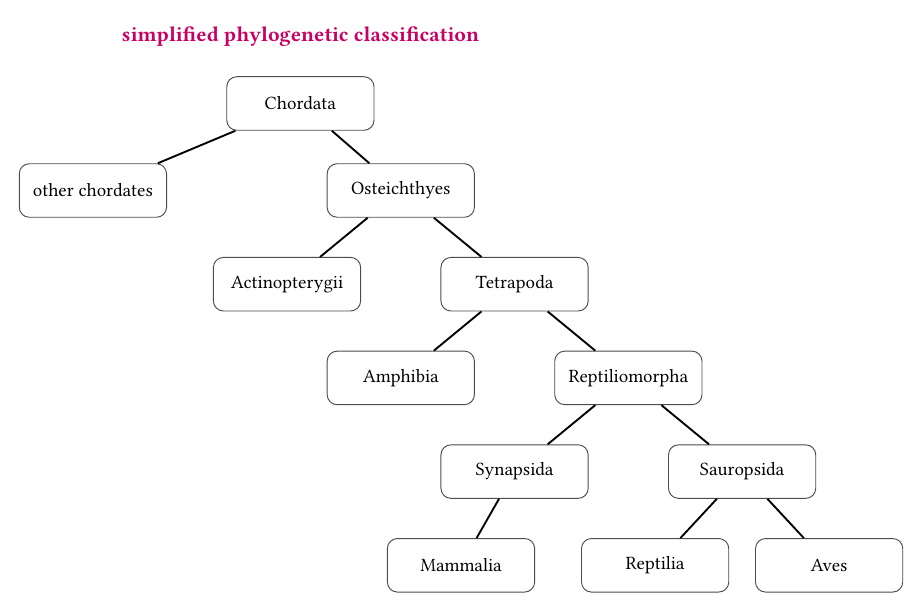
None of this makes a canary resemble a shark. A traditional ecological description and a phylogenetic classification may preserve different information about the same organism. The evidential question of who descended from whom is, however, not settled by our choice of terminology: ancestry is a claim about the history of life and can be supported or challenged by observations. The conventional element concerns how we decide to package those relationships into named groups.
Is a tomato a fruit?
Consider the tomato. In everyday culinary usage it is a vegetable, typically served in savoury dishes; botanically it is a fruit, developing from the ovary of a flower and containing seeds. The apparently contradictory statements concern two systems of classification, based on different attributes and serving different purposes. Rather than one modern definition simply correcting the other, they can coexist quite peacefully.
The distinction even reached the Supreme Court of the United States. In Nix v. Hedden (1893), the Court held that tomatoes were vegetables for the purposes of the Tariff Act of 1883, while explicitly acknowledging that botanically they are fruits [20]. The decision did not alter their biology; it interpreted a word within a particular legal context. A tomato may be a botanical fruit, a culinary vegetable, and a legally classified vegetable without contradiction, provided we keep the contexts distinct.
What unites the examples is not a supposed opposition between mathematical and scientific definitions. It is rather the difference between a criterion of classification and the properties of the classified objects. We can choose which properties matter for a given question, while the truth of empirical claims about those properties remains open to investigation. The classification does not replace the evidence; it organises it.
The boundaries of Europe
One might think that the question
What is Europe?
has a straightforward geographical answer. After all, Europe is a continent—or is it?
The difficulty begins with the word continent itself. If a continent is a large, continuous landmass, Europe and Asia are not separate continents at all: they form Eurasia. If we also disregard the Suez Canal as a boundary, we could go further and consider Afro-Eurasia a single landmass. Such definitions raise additional questions about islands: should Iceland, Great Britain, or Sicily belong to a continent if they are not physically connected to its mainland? And if an artificial waterway such as the Suez Canal can separate continents, why should other canals not do the same? Taken to an extreme, one might even wonder whether the Rhine–Main–Danube waterway could be used to draw a continental boundary through Germany. This is hardly a conventional geographical proposal, but it illustrates how much depends on the criteria we adopt.
Alternatively, we could identify continents with tectonic plates. This produces an entirely different picture. Iceland lies across the boundary between the North American and Eurasian plates, while Sicily occupies a complex region along the African–Eurasian plate boundary. Madeira, despite being Portuguese and conventionally associated with Europe, lies on the African plate.
The familiar geographical distinction between Europe and Asia is no less problematic. Their conventional boundary is often traced along the Ural Mountains, the Ural River, the Caspian Sea, the Caucasus, and the Turkish Straits. However, not all geographical conventions agree on the precise route. Depending on the definition, parts of Kazakhstan, Georgia, Azerbaijan, or Turkey may be assigned to Europe or Asia. Cyprus, geographically near the Asian mainland, is often treated as European for historical, cultural, and political purposes. Some classifications also prefer to assign entire countries to a single region rather than divide them along a geographical boundary. Consequently, Russia may be treated as a whole in one classification and divided between Europe and Asia in another.
The uncertainty is not merely geographical but historical. As Pagden observes [13], the eastern boundary of Europe has shifted repeatedly, having been associated at different times with the Don, the Volga, the Ob, and the Urals. These changes reflected not only geographical conventions but also changing attitudes towards Russia and its place within European civilisation. More generally, Europe has often been understood as a cultural identity defined partly through its contrast with an imagined non-European world. Its boundaries have therefore reflected historical, political, and cultural judgements as well as physical geography.
Islands and overseas territories make the situation even more interesting. Greenland belongs to the Kingdom of Denmark but is geographically associated with North America. French Guiana lies in South America yet forms an integral part of France and the European Union. French Polynesia is also French, but has a different relationship with the EU and is not part of its territory. Madeira is geographically close to northwestern Africa and geologically part of the African plate, but its history, institutions, population, and political status connect it closely to Portugal and Europe. There is no contradiction in these descriptions: they simply emphasise different properties.
We can complicate matters further by abandoning physical geography altogether. There is the European Union, the Council of Europe, the Eurozone, and the Schengen Area, each with its own membership rules and geographical extent. These are not alternative definitions of the continent in a strict sense, but institutional classifications that employ the idea of Europe for different purposes. Their boundaries need not coincide. The Council of Europe includes Armenia, Azerbaijan, and Georgia, while the European Union does not. Likewise, adopting the euro is not equivalent to belonging to the EU, and neither condition is determined by geography alone.
Moreover, political definitions of Europe are not necessarily stable over time. The United Kingdom left the European Union on 31 January 2020, while Russia was excluded from the Council of Europe on 16 March 2022. Did the British Isles suddenly cease to be geographically European? Did the expulsion of Russia somehow move the territory of the world’s largest country farther away from Europe? Of course not. What changed was membership in particular political institutions, not the geographical position of the countries concerned. Such changes can have substantial legal, economic, and political consequences, but they do not alter the underlying geography.
Sports and entertainment provide even more surprising examples. UEFA, the European football confederation, includes national associations such as Israel and Kazakhstan. The Eurovision Song Contest, despite its name, has allowed Australia to compete, because participation is governed by broadcasting arrangements and eligibility rules rather than continental geography. The Olympic Games and other international competitions similarly rely on their respective institutional structures.
Perhaps the most entertaining example is DVD Region 2. This commercial classification includes much of geographical Europe, but also Japan, Greenland, the Middle East, South Africa, and neighbouring territories, while excluding some countries commonly considered European. Clearly, nobody intended DVD Region 2 to provide a new theory of continental geography. Its purpose was to regulate the distribution and playback of films.
So, what is the actual Europe?
The name Europe itself illustrates this historical variability. In antiquity, it could designate a relatively restricted region associated with Thrace, an association reflected in Strabo’s Geography [19], while other usages extended it to mainland Greece and eventually to a much larger part of the known world. Even the geographical extent of the name has therefore changed considerably over time.
The essential point is not that Europe is imaginary, or that mountains, tectonic plates, coastlines, and political borders are arbitrary facts. These features are real, and our descriptions must respect them. What is conventional is which features we select to determine the extension of a particular concept. Different definitions can be reasonable precisely because they serve different purposes.
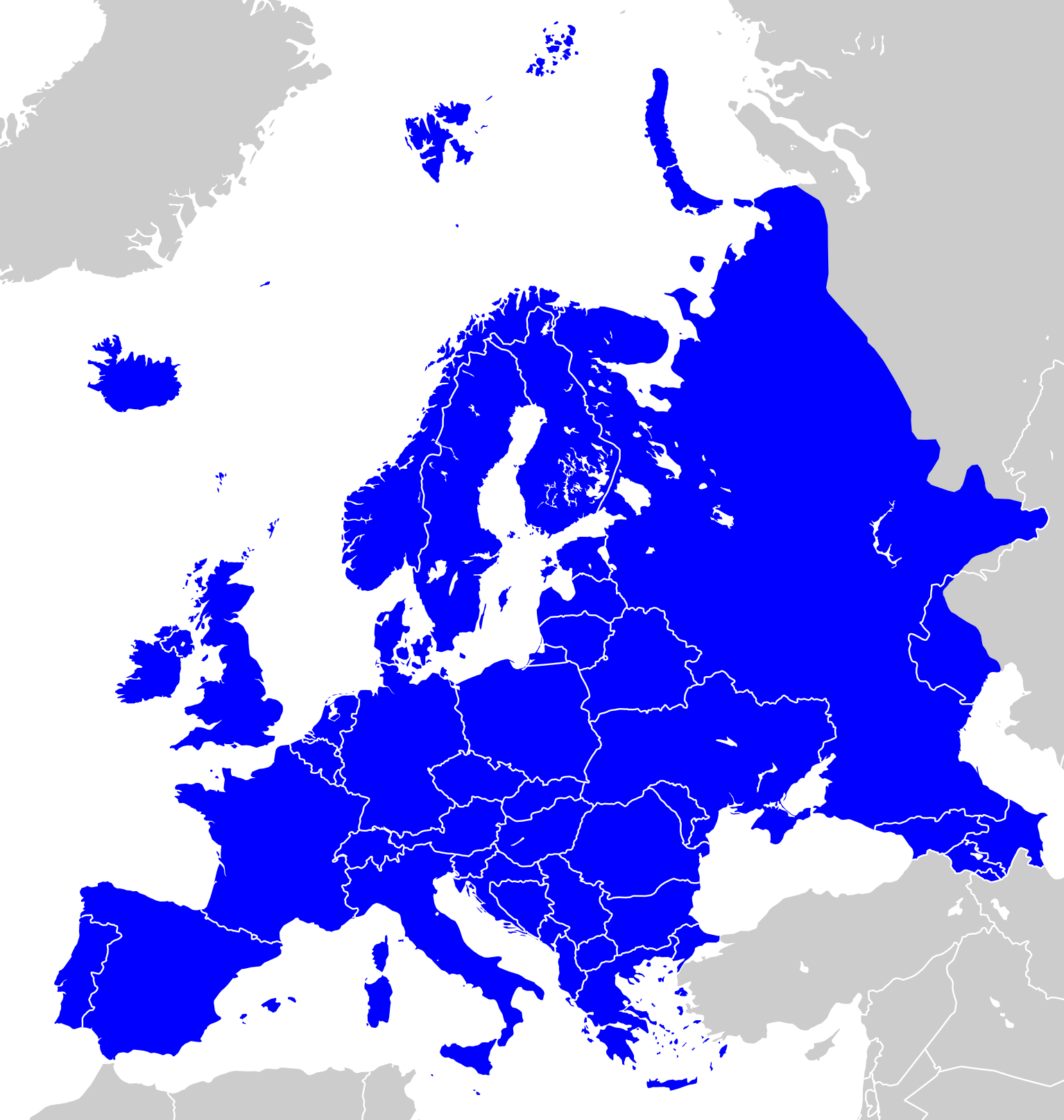
(a) The United Nations geoscheme of Europe.
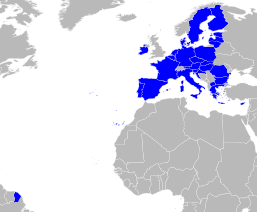
(b) The European Union.
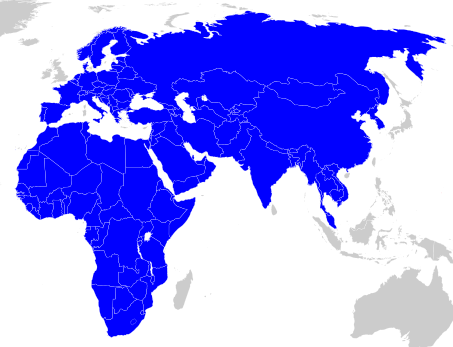
(c) The Afro-Eurasian landmass.
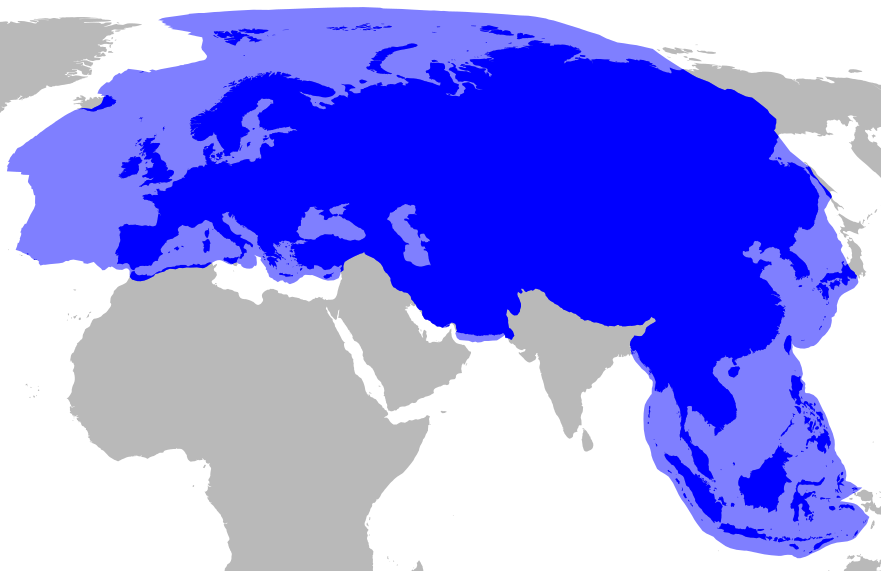
(d) The Eurasian tectonic plate.
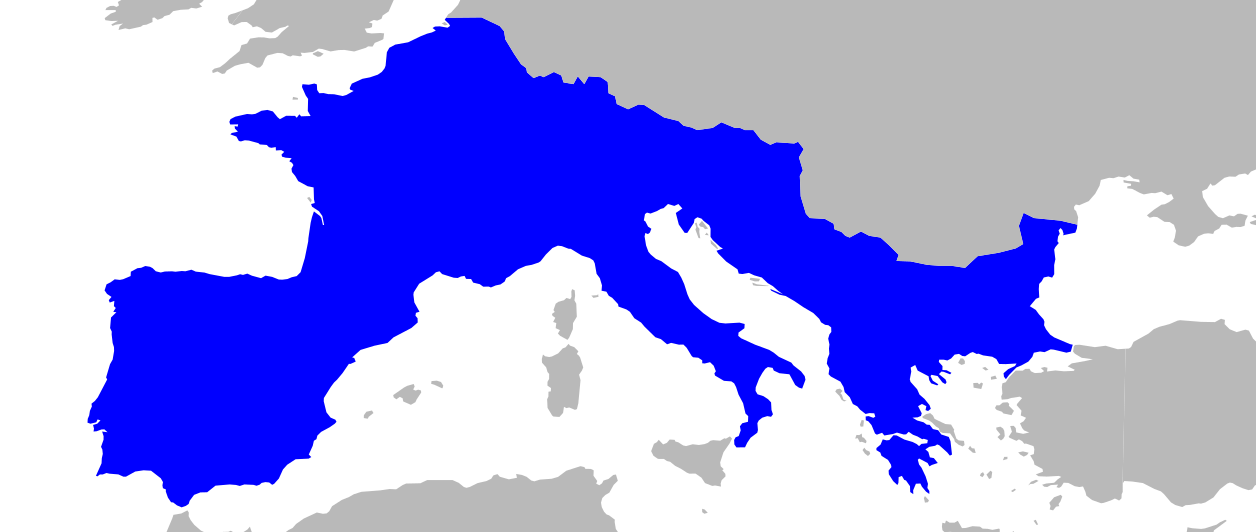
(e) Landmass defined by the Rhine–Main–Danube waterway.
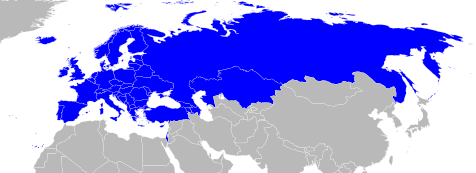
(f) The members of the Union of European Football Associations (UEFA).
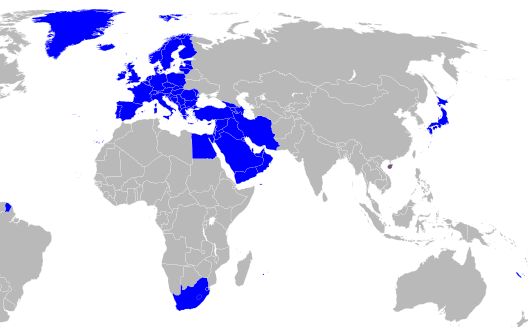
(g) DVD Region 2.
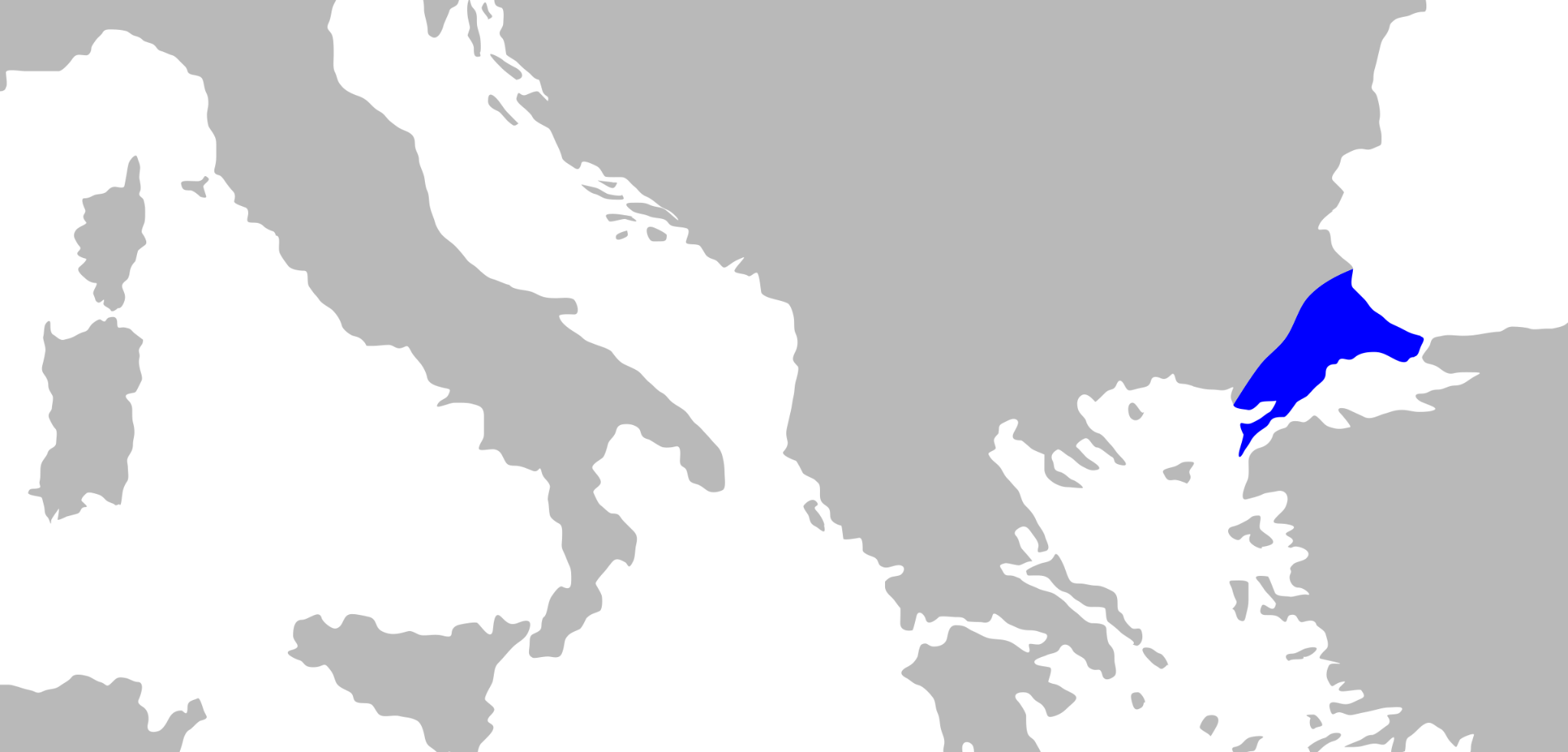
(h) Roman Province of Europe, ca. 400 AD.
If we want to know whether our national football team can enter a European competition, we should consult UEFA’s membership rules, not a tectonic map. If we want to know which currency is used in a country, we should examine membership of the Eurozone. If we need to determine whether EU legislation applies to an overseas territory, we should consult the relevant treaties. And if we want to buy a DVD player that can play a particular disc, the appropriate classification is the DVD region system—even if it places Japan and Eswatini in the same region.
The question, then, is not always
Which definition of Europe is the correct one?
but rather
Which definition of Europe is relevant to the question we are trying to answer?
Europe is not made less real by the existence of different definitions. But neither does its reality guarantee that there must be one uniquely privileged boundary suitable for every purpose.
The mathematics of concepts
The previous examples suggest that a concept can be approached through two questions: which objects fall under it, and which attributes characterise them? These complementary perspectives are formalised by Formal Concept Analysis, a mathematical theory of concepts and their hierarchies [10]. Only its basic ideas are needed for our purposes; the full theory extends much further.
Let \(G\) be a set of objects, \(M\) a set of attributes, and \(I\subseteq G\times M\) a relation. We write \(gIm\) when object \(g\) possesses attribute \(m\). The triple \[(G,M,I)\] is called a formal context. For example, imagine a simplified family consisting of a father, a mother, a son, and a daughter, described only through the attributes parent, child, male, and female. The context may be presented as a table:
| Object | Parent | Child | Male | Female |
|---|---|---|---|---|
| Father | \(\times\) | \(\times\) | ||
| Mother | \(\times\) | \(\times\) | ||
| Son | \(\times\) | \(\times\) | ||
| Daughter | \(\times\) | \(\times\) |
The table records only the chosen attributes; it does not purport to describe the complete nature of any of these people. This limitation is deliberate. Just as the botanical and culinary classifications of a tomato attend to different properties, a formal context describes the objects as seen through a chosen set of attributes.
For \(A\subseteq G\), let \(A'\) be the attributes shared by every object in \(A\): \[A'=\{m\in M:\ \forall g\in A,\ gIm\}.\] Conversely, for \(B\subseteq M\), let \(B'\) denote the objects possessing all attributes in \(B\): \[B'=\{g\in G:\ \forall m\in B,\ gIm\}.\] A formal concept is a pair \((A,B)\) satisfying \[A'=B,\qquad B'=A.\] The set \(A\) is its extent and \(B\) its intent. The first tells us which objects the concept contains; the second lists the attributes common to precisely those objects. For the family above, one formal concept is \[(\{\text{father},\text{son}\},\{\text{male}\}),\] and another is \[(\{\text{father}\},\{\text{parent},\text{male}\}).\] The second is more specific, describing fewer objects with more shared attributes.
We can order concepts by inclusion of their extents: \[(A_1,B_1)\leq(A_2,B_2)\quad\Longleftrightarrow\quad A_1\subseteq A_2.\] Equivalently, \(B_1\supseteq B_2\): the more specific concept has more attributes but fewer instances. The partially ordered set of formal concepts forms a complete lattice [10]. A Hasse diagram can represent its hierarchy, from more general concepts at the top to more specific ones below.
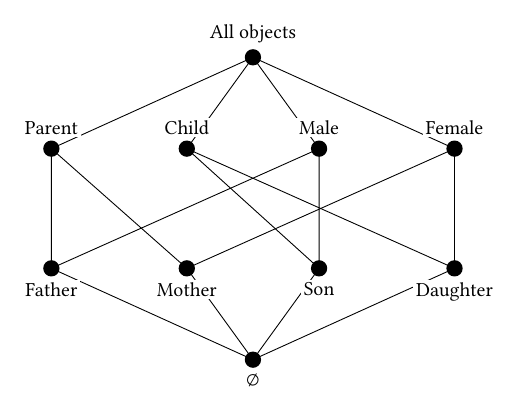
The same method could be applied to the Solar System. We might list celestial bodies and record whether each orbits the Sun, is nearly spherical, dominates its orbital neighbourhood, or possesses satellites. A new selection of attributes can yield a different context and a different concept lattice; additional observations may also change which attributes are assigned to which objects. In this way, the mathematical framework helps express the earlier story of changing planetary classifications.
Formal Concept Analysis does not decide which attributes we ought to use, or whether an observation is accurate. It does show that once a context is specified, the relationships between its formal concepts are mathematically determined. In other words, the freedom to choose a perspective and the rigour of the structure that follows from it are perfectly compatible.
Descriptions, names, and existence
Two definitions, one object
So far we have considered how different definitions lead to different classifications. The reverse phenomenon is equally interesting: two apparently different descriptions may turn out to identify the same object. A famous example is the Morning Star and the Evening Star. To observers, a bright object visible before sunrise and one seen after sunset may naturally receive different names. Yet both descriptions refer to Venus.
This distinction was central to Gottlob Frege’s discussion of sense and reference [9]. The two expressions can have the same referent while presenting it in different ways. Learning that the Morning Star is the Evening Star is informative, whereas learning that the Morning Star is itself is not: identifying the referents requires knowledge beyond merely repeating a name.
Mathematics is full of related discoveries. A notion may be introduced through a construction, then rediscovered through a second definition, only for a theorem to show that the two are equivalent. Sometimes the objects are literally equal; sometimes they are canonically isomorphic; sometimes the equivalence holds only under additional hypotheses. These differences deserve care, but they share a common feature: introducing a new definition does not ensure that one has introduced an essentially new mathematical object. Recognising an equivalence may be a substantial theorem rather than a matter of renaming.
Definitions therefore perform at least two jobs. They let us single out objects, and they provide language for investigating relationships among those objects. Establishing that two descriptions have the same reference can be a mathematical or empirical discovery even though the descriptions themselves are conventional.
Unicorns, dragons, and the monsters of classification
Now consider a more entertaining example: the unicorn. Most people imagine a horse-like creature with a single horn, sometimes associated with magical properties. Yet historical accounts differ considerably in appearance, temperament, and supposed abilities. In his travels, Marco Polo described animals he called unicorns in the kingdom of Basma. They were heavy, elephant-sized creatures, possessing a stout horn and enjoying mud; the description is generally understood to refer to rhinoceroses, and Polo explicitly contrasted them with the familiar unicorn of legend [16].
Was Polo wrong to call them unicorns? By modern zoological terminology the answer is yes, but the episode illustrates how an unfamiliar animal may be approached through a familiar, insufficiently defined category. When a description fits some observed characteristics but not others, we may revise the category, explain the discrepancies, or decide that we are dealing with something altogether different. None of these moves should be confused with evidence that the legendary animal exists exactly as described.
Dragons pose an even more flexible problem. Some traditions describe winged, fire-breathing reptiles; others describe serpentine creatures associated with water, weather, or supernatural power. The Komodo dragon, Varanus komodoensis, is a perfectly real animal [18], but its existence does not establish the existence of every creature that has ever been called a dragon. The answer to “Do dragons exist?” depends on the intended definition, and a shared name need not imply a shared concept.
Cryptozoological claims often suffer from this kind of ambiguity. A legendary creature may acquire different sizes, behaviours, and appearances in different accounts, so that almost any unfamiliar animal could be offered as evidence. This does not rule out the discovery of unknown species, or the possibility that folklore has been inspired by real ones. It does suggest that a scientifically investigable claim must specify its subject sufficiently well to make evidence relevant to it. Otherwise the apparent question of zoological existence becomes a shifting question of terminology.
Does love exist?
The issue becomes subtler when the subject is abstract. Consider the question:
“What is love?”
Love has been described as a divine power, an emotion, a biological process, a form of attachment, a moral commitment, and a relationship built over time. Ancient Greek discussions already distinguished forms of attachment and affection through terms such as ἔρως (érōs), φιλία (philía), and ἀγάπη (agápē), although neither their meanings nor their historical usages map neatly onto three exhaustive modern categories [15, 1]. Today, psychology and neuroscience investigate some of the processes associated with attraction and attachment, while philosophers continue to disagree about whether love is fundamentally an emotion, an attitude, a practice, or something else.
Now ask:
“Does love really exist?”
The question sounds profound, but before answering it we ought to determine what it refers to. If love means a set of emotional and physiological processes, its existence is open to scientific investigation. If it denotes a lasting pattern of mutual care and commitment, we can ask whether such relationships occur. If it means a supernatural force operating independently of known physical processes, we are considering a different hypothesis, one for which scientific assessment would require a suitably specified, testable account.
Thus two people may disagree about whether love exists while actually discussing different things. Someone may affirm the existence of observable attachment while another rejects a supernatural interpretation. Their conflict is not necessarily about the same proposition. This does not imply that every definition is scientifically adequate or that everyday language cannot function without strict formalisation. It means that, when a familiar word is promoted into a philosophical or scientific thesis, ambiguity can become a serious obstacle. A more useful question is often:
“Given this particular description of love, does anything satisfying it exist, and what evidence would establish that?”
This reformulation may be less poetic than the original, but it distinguishes disagreements about language from disagreements about the world. It also leaves room for genuinely difficult questions once a sufficiently clear interpretation has been fixed.
What’s in a name?
Shakespeare gives this question a memorable expression in Romeo and Juliet, when Juliet says [17]:
’Tis but thy name that is my enemy;
Thou art thyself, though not a Montague.
What’s Montague? It is nor hand, nor foot,
Nor arm, nor face, nor any other part
Belonging to a man. O, be some other name!
What’s in a name? That which we call a rose
By any other name would smell as sweet;
So Romeo would, were he not Romeo call’d,
Retain that dear perfection which he owes
Without that title. Romeo, doff thy name,
And for that name which is no part of thee
Take all myself.
Juliet’s rose would retain its fragrance under a different name, just as Pluto’s physical properties do not depend on its classification. Yet the play also supplies an essential qualification: the name Montague is not part of Romeo’s body or character, but the feud attached to that name has very real consequences for him and Juliet. Names need not determine the nature of things to shape how people act towards them. Shakespeare thus captures both sides of our argument: we must not confuse a name with what it names, but neither should we forget that conventions governing names can matter profoundly in human life.
Conclusions: what are we really arguing about?
Do natural numbers begin with zero, one, or two? We have seen that each choice can be studied precisely, and that the answer depends partly on which structure and which convention we intend. In Euclid’s arithmetic one was distinguished from number; in modern arithmetic it is a number but not a prime. Earth came to be called a planet, Pluto became a dwarf planet, birds were placed within dinosaur lineages, and tomatoes could be fruits without ceasing to be vegetables in the kitchen. The objects did not change merely because the terms did.
Yet it would be too simple to conclude that all definitions are arbitrary or equally useful. A definition can be consistent but unhelpful; it can conceal important differences, or fail to capture the relationships we hoped to study. In empirical sciences, the observations and historical claims used to support a classification may also be mistaken. Definitions can therefore be judged by their clarity, economy, explanatory power, and suitability for a particular purpose, while factual assertions must still answer to evidence.
Perhaps the lesson is to distinguish three questions that are frequently conflated:
“What do we mean?” “What satisfies that description?” “What follows from it?”
The first concerns our definitions, the second their applicability or reference, and the third their mathematical, logical, or empirical consequences. A disagreement may arise at any of these levels, and confusion between them can turn an elementary question into a seemingly profound mystery.
When two people argue about whether Pluto is a planet, whether one is prime, or whether love exists, the most useful first step may be neither to defend nor to reject the claim. It may be to ask whether they are talking about the same thing. A definition is not necessarily a discovery about the world, but choosing a good definition may be the beginning of one.
References
- Aristotle. 2009. The Nicomachean Ethics. Edited by Lesley Brown. Translated by W. D. Ross. Revised. Oxford World’s Classics. Oxford: Oxford University Press.
- Baum, David A., and Stacey D. Smith. 2013. Tree Thinking: An Introduction to Phylogenetic Biology. Greenwood Village, CO: Roberts and Company.
- Borges, Jorge Luis. 1941. “La biblioteca de Babel.” In El jardín de senderos que se bifurcan. Buenos Aires: Sur.
- Darwin, Charles. 1859. On the Origin of Species by Means of Natural Selection. London: John Murray.
- Dummit, David S., and Richard M. Foote. 2004. Abstract Algebra. 3rd ed. Hoboken, NJ: John Wiley & Sons.
- Enciclopedia della Matematica. n.d. “Peano, Assiomi Di.” Treccani. https://www.treccani.it/enciclopedia/assiomi-di-peano_%28Enciclopedia-della-Matematica%29/.
- Encyclopaedia Iranica. 2016. “Planets.” Encyclopaedia Iranica. https://www.iranicaonline.org/articles/planets/.
- Euclid. 2008. Euclid’s Elements of Geometry. Edited by Richard Fitzpatrick. https://www.math.unipd.it/~candiler/didafiles/matdue/EuclidsElements.pdf.
- Frege, Gottlob. 1892. “Über Sinn und Bedeutung.” Zeitschrift Für Philosophie Und Philosophische Kritik 100: 25–50.
- Ganter, Bernhard, and Rudolf Wille. 1999. Formal Concept Analysis: Mathematical Foundations. Berlin: Springer. https://doi.org/10.1007/978-3-642-59830-2.
- International Astronomical Union. 2006. “Resolution 5A: Definition of a Planet in the Solar System.” https://www.iau.org/IAU/Iau/News/PR2006/iau-2006-general-assembly-resolution-votes.aspx.
- O’Connor, John J., and Edmund F. Robertson. n.d. “Chrysippus of Soli.” MacTutor History of Mathematics, University of St Andrews. https://mathshistory.st-andrews.ac.uk/Biographies/Chrysippus/.
- Pagden, Anthony. 2002. “Europe: Conceptualizing a Continent.” In The Idea of Europe: From Antiquity to the European Union, edited by Anthony Pagden, 33–54. Cambridge: Cambridge University Press. https://doi.org/10.1017/CBO9780511496813.002.
- Peano, Giuseppe. 1958. “Arithmetices principia, nova methodo exposita (1889).” In Opere Scelte, edited by Ugo Cassina, II:20–55. Roma: Edizioni Cremonese.
- Plato. 1994. Symposium. Translated by Robin Waterfield. Oxford World’s Classics. Oxford: Oxford University Press.
- Polo, Marco. 1903. The Book of Ser Marco Polo, the Venetian: Concerning the Kingdoms and Marvels of the East. Edited by Henry Yule and Henri Cordier. 3rd ed. Vol. 2. London: John Murray. https://www.gutenberg.org/files/12410/12410-h/12410-h.htm.
- Shakespeare, William. Romeo and Juliet, Act 2, Scene 2. Folger Shakespeare Library. Read the text.
- Smithsonian’s National Zoo and Conservation Biology Institute. n.d. “Komodo Dragon.” Species information. https://www.nationalzoo.si.edu/animals/komodo-dragon.
- Strabo. 1924. The Geography of Strabo, vol. 3, Books VI–VII. Translated by H. L. Jones. Loeb Classical Library 182. Cambridge, MA: Harvard University Press.
- Supreme Court of the United States. 1893. “Nix v. Hedden, 149 U.S. 304.” https://supreme.justia.com/cases/federal/us/149/304/.
- University of Michigan. n.d. “Babylonian and Greek Astronomy.” Early Astronomy in the University of Michigan Collections. https://www.early-astronomy-um.org/ancient_intro.php.