Riddles and puzzles often rely on the ambiguity of natural language or simple mathematical expressions. Their appeal lies in the fact that the “most straightforward” interpretation is usually not the correct one. However, this genre of problems suffers from a fundamental paradox: while they claim to reward “thinking outside the box,” they in fact demand that the solver identify and adopt the precise box that the author had in mind.
The nature of riddles

Riddles exploit linguistic or cultural ambiguity. A famous classical example comes from Greek mythology: the riddle of the Sphinx, posed to Oedipus [12]. The Sphinx asked:
“What has four legs in the morning, two legs at noon, and three legs in the evening?”
The expected answer is “a human being,” who crawls on all fours as a baby, walks on two legs as an adult, and uses a cane in old age. The brilliance of this riddle lies in its metaphorical use of the “day” as a symbol of a human life cycle.
Yet this classical example already illustrates the general paradox: while the intended answer is elegant, it is not unique. One might imagine many alternative interpretations of the imagery—perhaps animals with life stages involving multiple forms of locomotion, or even objects that metaphorically acquire and lose supports. These would be equally valid under the literal phrasing of the riddle, but not what the author, or in this case the mythological tradition, intended.
A more contemporary and literary reinterpretation comes from George Orwell’s Animal Farm [7]. One could read the Sphinx riddle as describing Napoleon, the pig in charge of the revolt:
Four legs originally, as pigs naturally walk on all fours.
Then he starts walking on two legs, mirroring the pigs’ eventual adoption of human-like posture and tyranny.
Finally, he is propped up by the blood, sweat, and tears (three things you see) of the proletariat beneath him, symbolising the sacrifices of the other animals under his dictatorship.
This alternative interpretation demonstrates again that riddles often allow multiple valid readings, depending on cultural and literary context. This interpretation is presented in [8], among other possible solutions.
The story of Oedipus also underlines another feature of riddles: their function is not purely logical but cultural. The “correct” answer in myth was what allowed Oedipus to defeat the Sphinx, not necessarily the only logically consistent answer. Solving such riddles is thus less about logical reasoning and more about empathy: the solver must inhabit the symbolic world of the riddle’s author.
In modern riddle culture, this persists. Solvers often propose perfectly valid alternative interpretations, but these are dismissed as incorrect, not because they fail logically, but because they fail to match the author’s intention. The riddle thus becomes a test of cultural alignment and interpretative guessing rather than deductive reasoning.
The problem of rules
Even in apparently rigorous mathematical puzzles, ambiguity persists. Consider the classic “four nines” puzzle: 1
“Using exactly four ’s, form an expression equal to .”
The canonical solution is But why is concatenation ( from two ’s) allowed, while, say, decimals () or exponentials () might not be? What about factorials, square roots, logarithms, or trigonometric functions? Some puzzle traditions accept them, while others forbid them.
If we open the door to slightly different conventions, we find alternative and equally valid solutions. For example, by allowing decimals we may write: A (deliberately weirder) solution, illustrating how malleable these conventions can become, is where we allow the factorial , the natural logarithm , the floor function , and even a typographical/visual move: turning one upside down to read as a . Such visual or typographic manipulations sometimes appear in this genre as “out-of-the-box” moves that the author may have in mind; controversial, yes, but arguably no more or less “natural” than concatenation. If we want to stick to purely mathematical operations, one can instead write These expressions use exactly four ’s, obey the rules of arithmetic, and reach the target. Why should these be excluded, while is considered canonical? The only reason is that the “cultural box” of puzzle-solvers has decided that concatenation is more natural than introducing decimals and the floor function. Yet both are arbitrary conventions.
This highlights a deeper problem: unless the rules are explicitly stated, the puzzle is not mathematically well-defined. One could always invent a function such that , and claim it as a solution. The community implicitly draws a line somewhere—basic operations are allowed, concatenation is often allowed, exponentials and factorials are sometimes allowed, but “new” functions are not. Yet the placement of this line is never inherent to mathematics; it is imposed by tradition and expectation.
This problem gets even worse in quizzes such as:
“Using exactly the digits , , , , each exactly once, form the highest number possible.”
At first glance, the task seems straightforward. However, nothing in the formulation prevents the solver from adding an arbitrary number of factorial symbols “!” to the end of the expression, producing an extremely large number.
A natural compromise might seem to be restricting ourselves to the class of elementary functions. This notion, introduced by Joseph Liouville in the 1830s, refers to functions that can be constructed, via addition, multiplication, division, and composition, from constant functions, exponential functions, the complex logarithm, and roots of polynomials whose coefficients are themselves elementary [3], [4]. Within this framework, certain operations—such as factorial—are excluded, since they do not belong to the class of elementary functions.
At first glance, this restriction might appear to provide a clean and principled boundary. Yet difficulties arise even here. Consider concatenation: one could argue that writing from two ’s corresponds to the elementary function (with ). But if we accept this definition, we have implicitly introduced two new digits— and —which were not part of the original puzzle. Should this be allowed? If not, then concatenation should be forbidden. If yes, then what prevents us from admitting arbitrary ad hoc polynomial functions carefully designed to produce the desired result?
In short, even the appeal to Liouville’s rigorous definition does not fully resolve the ambiguity of which rules should count as “natural” in this kind of puzzle.
Thus, solving such puzzles is not truly a test of mathematical reasoning, but of cultural literacy within the puzzle community. The solver must guess which operations the author tacitly deemed acceptable, and which were silently ruled out. The exercise becomes one of guessing the right “box,” rather than actually thinking beyond it.
Sequence puzzles
The paradox is most evident in “complete the sequence” problems. Given the first terms of a sequence, one is asked to produce the -st. Mathematically, this is hopeless, as there are uncountably many functions that agree with the first values and diverge thereafter. Polynomial interpolation of degree alone already guarantees infinitely many possible continuations.
Take the simple and apparently innocuous puzzle:
Using the sequence of numbers what is the next term?
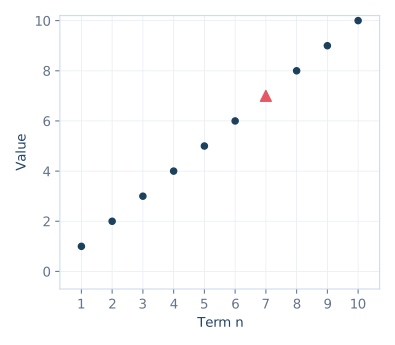 Identity sequence. Here the solution is 7.
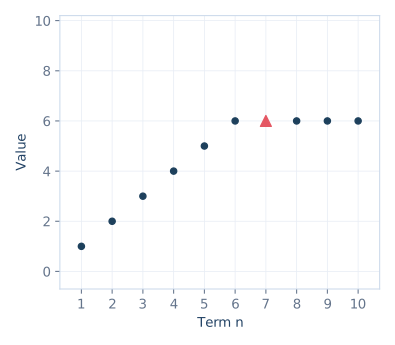 CDF of a fair die, expressed in sixths. Here the solution is 6.
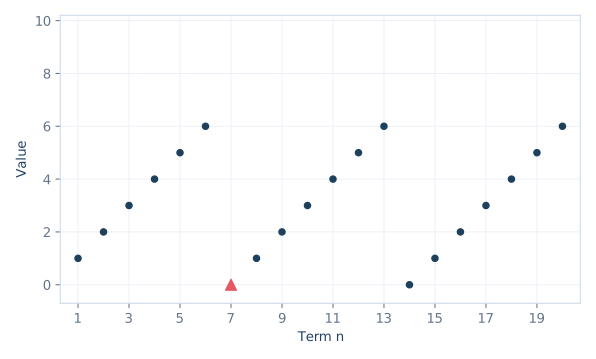 Periodic sequence modulo 7. Here the solution is 0.
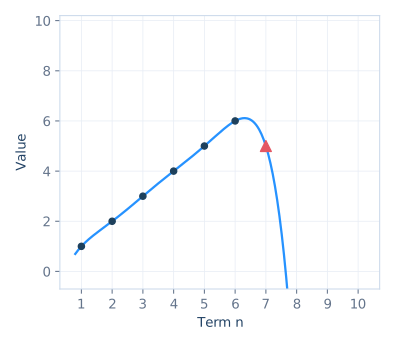 An interpolating polynomial p, with p(7) = 5. Here the solution is 5.
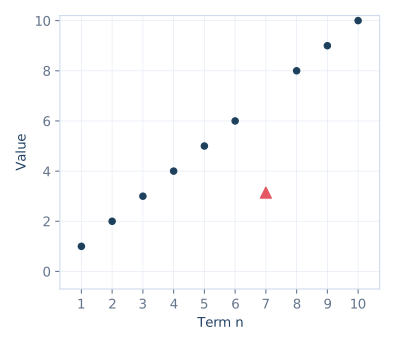 Modified identity sequence a, with a₇ = π. Here the solution is π.
The “obvious” continuation is , assuming the natural numbers. But there are many equally reasonable alternatives:
, if these are interpreted as the divisors of in increasing order.
, if they are divisors of .
, if they are divisors of .
, if we are looking at the cumulative distribution function of a fair die expressed in sixths, which plateaus once the maximum value is reached.
, if we are working modulo , e.g., modelling days of the week.
All of these and many others are valid and follow natural, recognisable rules. None is mathematically more “correct” than the others, unless we impose additional assumptions about simplicity, cultural relevance, or tradition. But these criteria are subjective. To a number theorist, “divisors of 60” is elegant. To a probabilist, the die cumulative distribution function is natural. To a schoolchild, “just 7” is obvious. To a mathematician, all of them are equally valid. Moreover, let us stress that the solution can be any arbitrary number , if we allow a degree polynomial interpolation through the six given terms and . Thus, the task is never to deduce the next number uniquely, but to divine the author’s intended framing.
But it can become even “weirder.” In mathematics, a definition by cases has no less validity than an explicit formula. Therefore, even a rule like has the same validity as the ones expressed above. In this case, the solution would be . And of course, we can replace in the definition by any other number to accommodate whatever solution that we want.
Some of the possible solutions discussed are represented in Figure Figure 2.
It is worth noting that the problem is even more pronounced when the intended solution lies outside mathematics altogether. A sequence could be drawn from linguistics (e.g., numbers whose names start with a certain letter), cultural trivia (lengths of reigns of monarchs), or arbitrary real-world data (population by decade). In such cases, no amount of logical reasoning will recover the rule: the solver either knows the trick, or they do not.
As noted by Martin Gardner in his writings on recreational mathematics [2], “complete the sequence” puzzles are often underdetermined and highlight the difference between genuine mathematical reasoning and cultural guessing. He emphasised that these puzzles are more about recognising the intended pattern than logically deducing a unique next term.
Meaning Matters
Of course, this does not imply that predicting elements of a sequence is always impossible. The difficulty arises primarily from a lack of information: if we understand what the sequence represents, we may identify a natural rule and extrapolate further terms. In fact, this is the standard approach in physics and other natural sciences, where patterns are observed across repeated phenomena, models are constructed—often using interpolation methods such as linear regression—tested against new data, and refined as necessary.
Similarly, in mathematics, knowing the context or the class of admissible functions can restrict the scope of possibilities. For example, if we know that a sequence is generated by a polynomial of degree , then points are sufficient to determine a unique interpolating polynomial. This restriction allows a precise prediction of the next term.
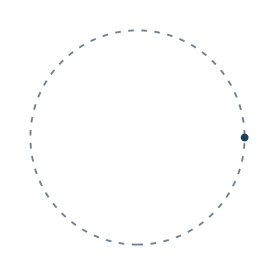 1 point · 1 region
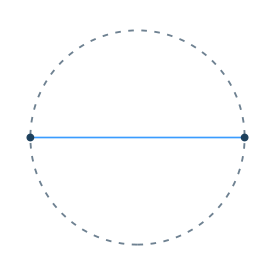 2 points · 2 regions
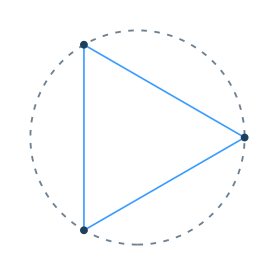 3 points · 4 regions
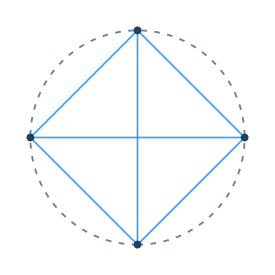 4 points · 8 regions
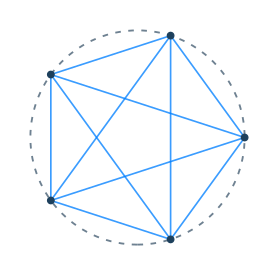 5 points · 16 regions
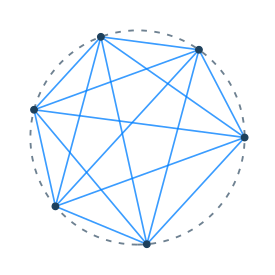 6 points · 31 regions
Sequences that represent a specific mathematical “phenomenon” allow precise predictions. A classical example is provided by Moser’s circle problem, which asks for the maximal number of regions into which a circle can be divided by connecting points on its circumference with straight lines [6], [11]. The first terms of the sequence are At first glance, if presented without context, one might reasonably guess that the next term should be , continuing the doubling pattern. However, once we recall the actual meaning of the sequence, we can compute the correct value for six points, as shown if Figure Figure 3: there are regions, not . In fact, the precise formula is
or, written without the binomial coefficient, This indeed yields the sequence This example makes clear that meaning matters: purely symbolic continuation can mislead, while a sequence grounded in a mathematical definition yields a unique, correct extension.
To conclude, while knowing the meaning or the functional class of a partial sequence may allow us to predict its continuation, puzzles of the form “complete the sequence” present strings of abstract symbols without context. Such sequences carry no inherent information, and thus no unique continuation can be determined. Any proposed extension is necessarily speculative, and all are equally valid.
Sequences in popular culture
We may summarise the situation of sequence puzzles as follows. If the puzzle’s intended answer lies within mathematics, then infinitely many answers exist, and the problem is underdetermined. If it lies outside mathematics, then no purely logical method can recover it: the solver must rely on guessing cultural or linguistic associations.
An amusing real-world example comes from popular culture. The singer Adele names her albums after her age: 19, 21, 25, and 30 (see Figure Figure 4). Some mathematicians and fans have speculated about a hidden pattern that could predict the title of her next release. Indeed, a search in the vast On-line Encyclopedia of Integer Sequences (OEIS) reveals nine sequences containing [1]. For example, sequence A142958 [10] continues with , while A072666 [9] gives as the next entry. However, such matches are somewhat arbitrary: the OEIS contains thousands of sequences, and any four numbers can usually be extended in many different ways. But, as already mentioned, these sequences are only a small subset of the infinitely many ways one could continue the sequence. In reality, any number could plausibly follow the set , which underlines the same paradox discussed above: while it is tempting to “find the pattern,” there is no unique or objectively correct answer. Ultimately, the most natural rule governing this sequence is simply the ages at which Adele released her albums. While this rule is not “mathematical” in the conventional sense, it is nonetheless a valid and well-defined rule for the sequence. Any other numerical continuation suggested by the OEIS or by pattern-finding is speculative. The only way to know the next term with certainty is to wait for the release of Adele’s subsequent album.
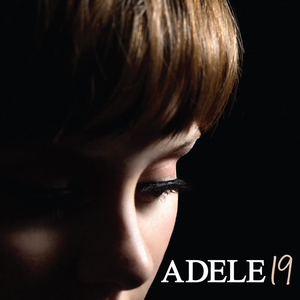 19 (2008)
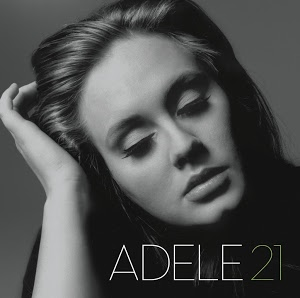 21 (2011)
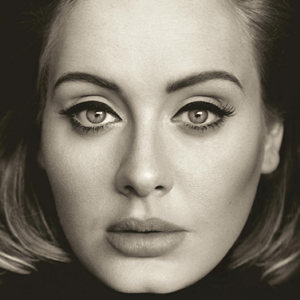 25 (2015)
 30 (2021)
Guillermo Martínez’s novel The Oxford Murders [5] constructs a mystery whose solution heavily relies on the ambiguities and flaws of sequence puzzles. The story follows two mathematicians who become entangled in a series of cryptic murders, each accompanied by a different geometric symbol, beginning with a circle. The plot centres on deciphering the next symbol in the sequence, a task that blends mathematical reasoning with detective work. The narrative builds on the challenges of interpreting patterns under incomplete information and the multiple possible rules that can be imposed on sequences. We refrain from giving further details here to avoid spoilers, but the novel provides a literary demonstration of the same paradox discussed above: the tension between “finding the rule” and the potentially limitless number of rules that can fit the observed data.
The core paradox
The essential paradox is that these puzzles advertise themselves as exercises in creativity and lateral thinking—“thinking outside the box.” Yet in reality they require the solver to identify the specific box the author had in mind. To succeed, one must conform to the author’s unstated rules, which may be cultural, linguistic, or conventional rather than mathematical or logical.
In this sense, such puzzles are not genuine exercises in logic or mathematics. They masquerade as deductive challenges, but are in fact tests of empathy and cultural alignment. They measure not the solver’s creativity, but their ability to reproduce the puzzle-maker’s thought process. What appears as a free exploration of possibilities is actually a constrained search for the one conventionally acceptable solution.
This suggests that sequence puzzles and similar riddles are best understood not as mathematics, but as cultural artefacts: games of shared assumptions, language, and tradition. Their paradox lies precisely in this mismatch between appearance and reality: they pretend to reward originality, but in truth reward conformity to an unseen standard.
The puzzle of writing using four instances of the digit belongs to a long tradition of recreational mathematics riddles, such as the classic “four fours” puzzle, which has appeared in collections since the early twentieth century and was popularised by Martin Gardner [2]. Its many variants, including the “four nines” form, are now considered part of mathematical folklore.↩︎
References
A. Bonato, “Adele’s ‘30’: A mathematician explores number patterns in album titles,” The Conversation, Dec. 1, 2021. Available: https://theconversation.com/adeles-30-a-mathematician-explores-number-patterns-in-album-titles-172677
Gardner, Martin. Mathematical Puzzles and Diversions. Penguin Books Ltd, 1991.
J. Liouville. Premier mémoire sur la détermination des intégrales dont la valeur est algébrique. Journal de l’École Polytechnique, tome XIV:124–148, 1833.
J. Liouville. Second mémoire sur la détermination des intégrales dont la valeur est algébrique. Journal de l’École Polytechnique, tome XIV:149–193, 1833.
Martínez, Guillermo, translated by Sonia Soto. The Oxford Murders. Penguin, 2006.
Leo Moser and W. Bruce Ross, “On the Danger of Induction,” Mathematics Magazine, Vol. 23, No. 2 (Nov.–Dec. 1949), pp. 109–114.
Orwell, George. Animal Farm. Secker & Warburg, 1945.
Puzzling Stack Exchange. “Alternative solutions to the riddle of the Sphinx,” https://puzzling.stackexchange.com/questions/15754/alternative-solutions-to-the-riddle-of-the-sphinx, accessed August 2025.
N. J. A. Sloane (ed.), The On-Line Encyclopedia of Integer Sequences, entry A072666. https://oeis.org/A072666, accessed October 3, 2025.
N. J. A. Sloane (ed.), The On-Line Encyclopedia of Integer Sequences, entry A142958. https://oeis.org/A142958, accessed October 3, 2025.
N. J. A. Sloane (ed.), The On-Line Encyclopedia of Integer Sequences, entry A000127. https://oeis.org/A000127, accessed October 3, 2025.
Sophocles, translated by Dudley Fitts and Robert Fitzgerald. The Oedipus Cycle: Oedipus Rex, Oedipus at Colonus, Antigone. Mariner Books, 2002.