
The concept of “indeterminate forms” is ubiquitous in calculus teaching, yet it often generates confusion and misinterpretation. Expressions such as \(0/0\) or \(0^0\) are commonly labelled “indeterminate,” which can mislead students into thinking that these expressions take arbitrary values. In this note, we argue that this terminology is largely a linguistic abuse. We emphasise that \(0/0\) is strictly undefined in arithmetic, whereas \(0^0\) can be consistently defined as \(1\), with natural motivations arising in combinatorics, algebra, and type theory, even though it appears as an “indeterminate form” in limit computations. By clearly distinguishing between undefined arithmetic expressions and indeterminate limit forms, we advocate for pedagogical precision that prevents the unwarranted transfer of ambiguity from limits to arithmetic operations.
Introduction
The notion of “indeterminate forms” is common in calculus textbooks. While it is useful for describing limits, it is often misunderstood. In particular, students frequently conflate arithmetic expressions with limit forms, leading to misconceptions such as \(0/0\) being “any number” or \(0^0\) being inherently undefined.
To ensure precision, we recall that the real numbers \(\mathbb{R}\) form an ordered field that is complete [6]. That is, \(\mathbb{R}\) satisfies the usual field axioms (addition, multiplication, distributivity, existence of inverses), is equipped with a total order compatible with the field operations, and every inhabited subset bounded above has a least upper bound. For standard treatments of real analysis and the construction of the real numbers, we refer the reader to [7][1].
Within this framework, one can define arithmetic operations such as addition, subtraction, multiplication, quotient, and exponentiation of two real numbers in a rigorous and structural manner, whenever the corresponding operation is well defined. For instance, the quotient \(a/b\) is introduced as the inverse operation to multiplication: it is defined only in those cases where the equation \(b \cdot x = a\) admits a unique solution in \(\mathbb{R}\). Thus division by zero is excluded not by convention but by necessity, since the equation \(0\cdot x=a\) either has no solution (if \(a\neq 0\)) or infinitely many (if \(a=0\)), and therefore cannot define a single number.
Likewise, exponentiation \(a^b\) extends the classical notion of repeated multiplication familiar from natural-number exponents, but its extension to real exponents cannot be made uniformly for all real bases. When \(a>0\), one may define \(a^b\) via the exponential and logarithmic functions; however, if \(a<0\), only integer exponents are allowed, and when \(a=0\) additional restrictions are necessary. The full discussion of these cases will appear later, but what matters here is that certain expressions—such as division by zero or exponentiation with a negative base and a non-integer exponent—are simply not defined as arithmetic operations on the real numbers.
We also recall the notion of a limit of a function. For a function \(f\) defined on some neighbourhood of \(a \in \mathbb{R}\) (possibly excluding \(a\)), we write \[\lim\limits_{x \to a} f(x) = L\] if \(f(x)\) approaches \(L\) as \(x\) approaches \(a\). Limits can be finite (e.g., \(\lim\limits_{x \to 0} x^2 = 0\)), infinite (e.g., \(\lim\limits_{x \to 0} 1/x^2 = +\infty\)), or may not exist (e.g., \(\lim\limits_{x \to 0} \sin(1/x)\) does not exist).
Limits commute with the common operations whenever all the involved expressions are defined. Concretely, if \(f,g\) are functions and \(L = \lim\limits_{x\to a} f(x)\), \(M = \lim\limits_{x\to a} g(x)\) exist, then 1 \[\lim_{x\to a} (f(x) + g(x)) = L + M, \quad \lim_{x\to a} (f(x) - g(x)) = L - M,\] \[\lim_{x\to a} (f(x) \cdot g(x)) = L \cdot M, \quad \lim_{x\to a} \frac{f(x)}{g(x)} = \frac{L}{M} \quad (M\neq 0),\] \[\lim_{x\to a} f(x)^{g(x)} = L^M \quad (\text{if }L>0).\]
When applying these rules formally leads to an expression that is not defined (e.g., \(0/0\) or \(0^0\)), such expressions are often called “indeterminate forms” [9]. This terminology can be misleading: the fact that a formal application of the limit laws produces an undefined expression does not mean that the limit itself cannot be determined. It only indicates that the standard limit rules cannot be applied directly, and further analysis of the functions involved is required.
For example, consider \[\lim_{x \to 0} \Bigl( \frac{1}{x^2} - \frac{1}{x^2} \Bigr).\] A naive attempt to commute the limit with the terms might suggest \[\lim_{x \to 0} \frac{1}{x^2} - \lim_{x \to 0} \frac{1}{x^2} = \infty - \infty,\] an “indeterminate form” of the type \(\infty - \infty\). However, this is misleading: the actual limit can be easily computed by simplifying the expression first: \[\frac{1}{x^2} - \frac{1}{x^2} = 0.\] Thus, \[\lim_{x \to 0} \Bigl( \frac{1}{x^2} - \frac{1}{x^2} \Bigr) = 0.\] This very simple example shows that encountering an “indeterminate form” does not imply that the limit cannot be determined; it only signals that the standard limit rules cannot be applied blindly and some algebraic simplification or other analysis may be required.
Moreover, the terminology often leads to an additional and widespread confusion: the phrase “indeterminate form” is frequently (and incorrectly) transferred from the context of limits to the context of arithmetic, as if expressions like \(0/0\) or \(0^0\) were “indeterminate” in the sense of possessing multiple possible numerical values. This is not the case. An arithmetic expression is either defined or not defined; it is never “ambiguous’’ or “multi-valued.’’ The role of “indeterminate forms’’ is purely analytic: they indicate that naive limit rules break down and that further work is needed.
In what follows, we examine in detail the two classical examples \(0/0\) and \(0^0\), clarifying the distinct reasons for which the first is truly undefined as an arithmetic operation, while the second admits a meaningful and widely adopted definition.
The Case of \(0/0\)
Given two real numbers \(a,b\) with \(b\neq 0\), the quotient of \(a\) by \(b\), denoted \(a/b\), is defined as the unique real number \(x\) satisfying \[a = x \cdot b.\] This definition explicitly excludes the case \(b=0\). Consequently, expressions such as \[\frac{1}{0}, \quad \frac{2}{0}, \quad \frac{-1}{0}, \quad \frac{\pi}{0}, \quad \text{and in particular} \quad \frac{0}{0}\] are all undefined in the real numbers.
It is important to distinguish between solving an equation and performing an arithmetic operation. For example, one may solve the equation \[0 = x\cdot 0,\] whose solution set is all real numbers. But this does not imply that the quotient \(0/0\) can take any real value. The expression \(0/0\) represents an arithmetic operation, and this operation is simply not defined in the real numbers.
In calculus, one often encounters limits of the form \[\lim\limits_{x \to a} \frac{f(x)}{g(x)},\] where both \(f(x) \to 0\) and \(g(x) \to 0\) as \(x \to a\). It is important to note that the usual rule \[\lim_{x \to a} \frac{f(x)}{g(x)} = \frac{\lim\limits_{x \to a} f(x)}{\lim\limits_{x \to a} g(x)}\] can only be applied when \(\lim\limits_{x \to a} g(x) \neq 0\); otherwise, the expression on the right-hand side is not defined.
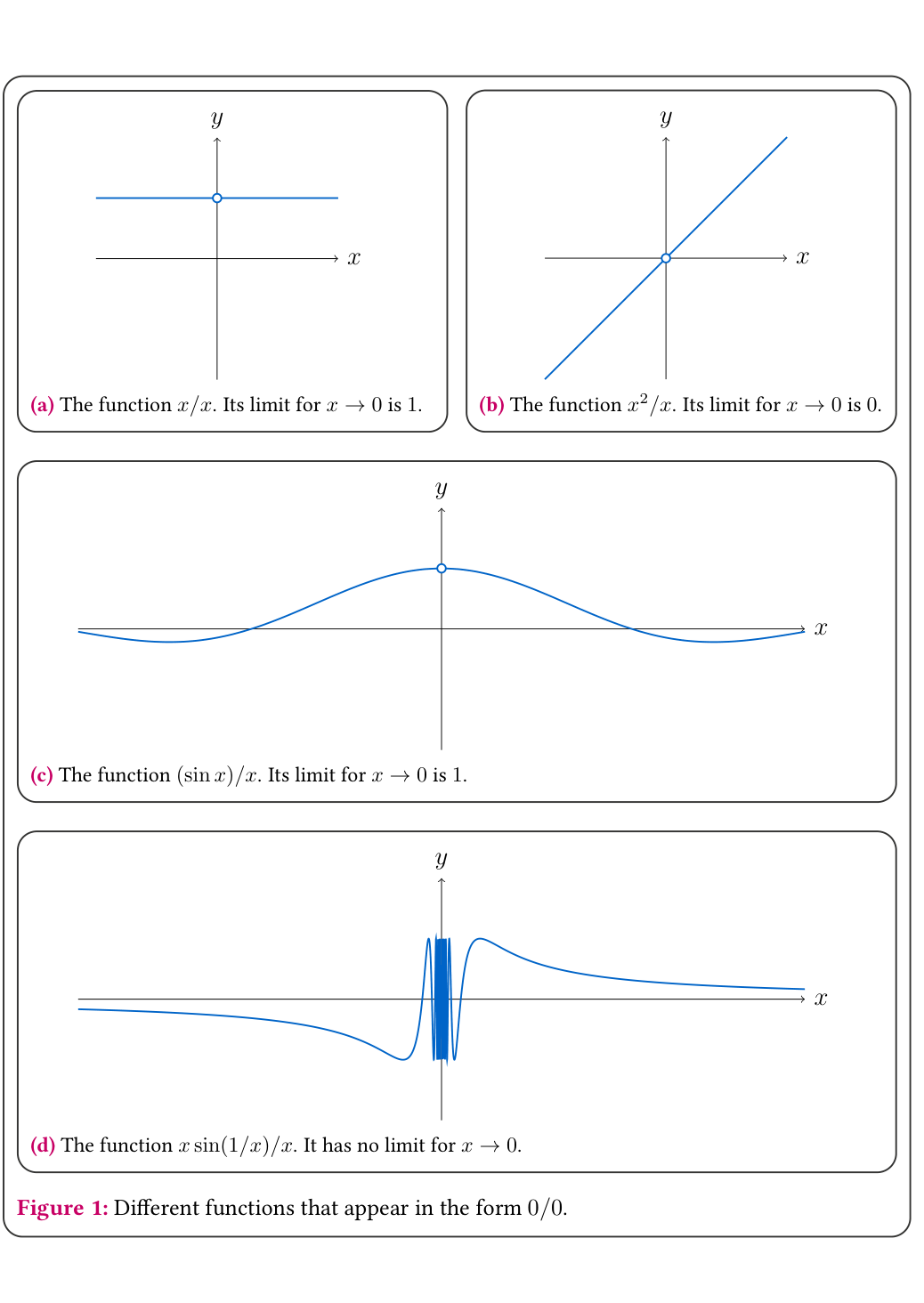
A few simple examples exemplify the situation:
\[\lim\limits_{x \to 0} \frac{x}{x} = 1, \quad \lim\limits_{x \to 0} \frac{x^2}{x} = 0, \quad \lim\limits_{x \to 0} \frac{\sin x}{x} = 1.\]
In each case, the naive application of the quotient rule would suggest \(0/0\), an “indeterminate form.” However, the actual limits are well-defined and easily computable. This shows that labelling such limits as “indeterminate forms” can be misleading: it does not imply that the limit cannot be determined, only that further analysis or algebraic manipulation is required to compute it.
It is also important to note that a limit of the form \[\lim_{x \to a} \frac{f(x)}{g(x)}\] with \(f(x) \to 0\) and \(g(x) \to 0\) may fail to exist. For instance, consider the following two functions defined in \(\mathbb{R}\smallsetminus\{0\}\): \[f(x) = x \sin\frac{1}{x}, \quad g(x) = x.\] Then \[\lim_{x \to 0} f(x) = 0, \quad \lim_{x \to 0} g(x) = 0,\] but \[\frac{f(x)}{g(x)} = \sin\frac1x\] does not have a limit, because \(\sin(1/x)\) oscillates infinitely between \(-1\) and \(1\) as \(x \to 0\).
In this case, we have an “indeterminate form” \(0/0\) that does not have a limit. However, this does not mean that the limit can take any value: it simply does not exist. This reinforces the idea that “indeterminate form” is a warning about the failure of naive limit laws, not a property of a number itself.
Functions discussed in this section are represented in Figure 1.
The Case of \(0^0\)
We recall the definition of exponentiation of real numbers \(a^b\), which generalises the familiar exponentiation of natural numbers. The definition depends on the values of \(a\) and \(b\):
If \(a>0\), then \(a^b\) is defined by \[a^b := \exp(b \ln a),\] using the natural logarithm and exponential functions.
If \(a<0\), then \(a^b\) is defined only if \(b \in \mathbb{Z}\) (an integer), in which case \[a^b := -(-a)^b \quad \text{if $b$ is odd}, \quad a^b := (-a)^b \quad \text{if $b$ is even}.\]
If \(a=0\) and \(b>0\), then \(0^b := 0\).
If \(a=0\) and \(b<0\), then \(0^b\) is undefined, since it would require division by zero.
If \(a=0\) and \(b=0\), we face the natural question: what value, if any, should we assign to \(0^0\)? This is the case of interest and will be discussed in detail below.
As recalled above, the limit \[\lim_{x \to a} f(x)^{g(x)}\] can commute in general only when \(\lim\limits_{x \to a} f(x) > 0\). Therefore, expressions of the form \(0^0\) appearing in limits are among those often labelled “indeterminate forms.”
Consider two simple examples, represented in Figure 2:
\[\lim_{x \to 0^+} x^0 = 1, \quad \lim_{x \to 0^+} 0^x = 0.\]
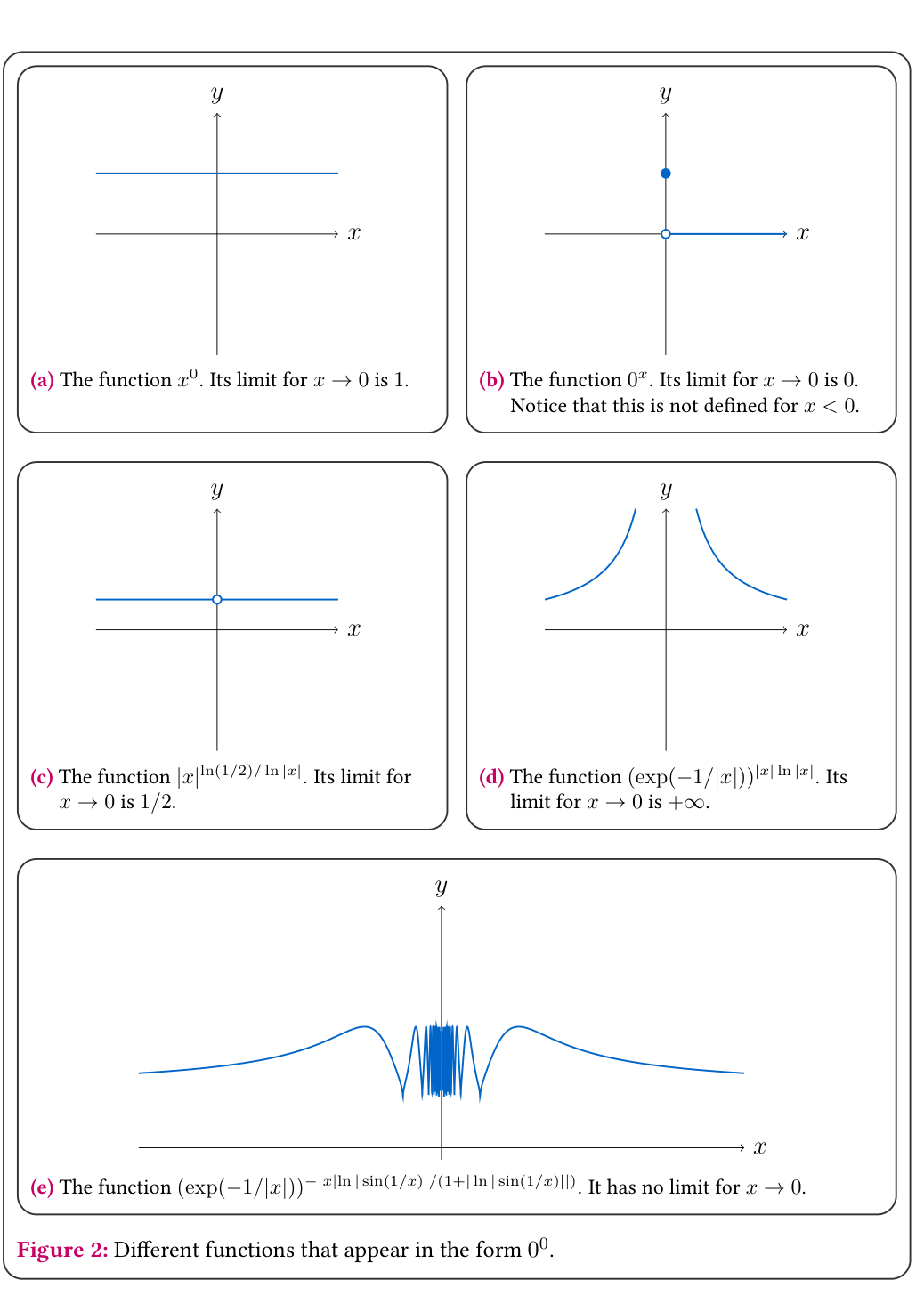
Both have the superficial form \(0^0\), yet the limits are different. This explains why \(0^0\) is called an “indeterminate form” in the context of limits: the limit value depends on the specific functions involved.
In fact, one can easily construct a function of the form \(f(x)^{g(x)}\) approaching \(0^0\) whose limit at \(x=0\) equals any given non-negative real number \(\alpha\). For instance, consider \(\alpha> 0\) and the function \[h(x) = |x|^{\ln \alpha/ \ln|x|}.\] It’s easy to check that this function equals \(\alpha\) for all \(x\neq 0\) and is undefined at \(x=0\). Therefore, its limit as \(x\to 0\) is \[\lim_{x\to 0} h(x) = \alpha.\] One can go further: for example, consider \[\left(\exp\!\left(-\tfrac{1}{|x|}\right)\right)^{\,|x|\ln|x|}.\] Here both the base and the exponent tend to \(0\) as \(x\to 0\), so the expression is formally of the type \(0^0\). Yet for all \(x\neq 0\) where the expression is defined, a direct computation gives \[\left(\exp\!\left(-\tfrac{1}{|x|}\right)\right)^{\,|x|\ln|x|} = \exp\!\left(-\frac1{|x|}\cdot |x|\ln|x|\right) = |x|^{-1},\] and thus the limit as \(x\to 0\) is \(+\infty\). Similarly, one may construct a \(0^0\)-type expression whose limit does not exist. For instance, \[\left(\exp\!\left(-\tfrac{1}{|x|}\right)\right)^{-|x| \frac{\ln|\sin(1/x)|}{1+|\ln|\sin(1/x)||}}\] has both base and exponent tending to \(0\) as \(x\to 0\), yet the resulting function oscillates and does not admit a limit at \(0\). Details are left to the reader.
These examples show that expressions of the form \(0^0\) in limits can exhibit a wide range of behaviours. This reinforces the point that “indeterminate form’’ does not mean “ambiguous value’’—it only signals that the limit cannot be evaluated by naively substituting the limiting values of the base and exponent.
One may then ask: does this mean that the arithmetic expression \(0^0\) is undefined? Not necessarily. Unlike \(0/0\), which is strictly undefined in arithmetic, \(0^0\) can be consistently defined to equal \(1\). It is true that in real analysis or basic arithmetic, some authors prefer to leave \(0^0\) undefined to avoid confusion with limit forms. However, in a broader mathematical context, defining \(0^0 = 1\) is natural and, in many models, the only definition that makes sense.
In set theory (e.g., Zermelo-Fraenkel [3]), the cardinal exponentiation \(A^B\) counts the number of functions from \(B\) to \(A\). When \(A\) and \(B\) are both empty sets, there is exactly one function: the empty function. Hence, \(0^0 = 1\) in this sense.
Similarly, in type theory (e.g., Martin-Löf type theory [5]), there is exactly one function from the empty type to itself, again giving \(0^0 = 1\).
In combinatorics, the set-theoretic definition can be applied to count the number of functions from an empty set to an empty set, which is 1. Moreover, defining \(0^0 = 1\) ensures that binomial identities such as \[(x+y)^n = \sum_{k=0}^n \binom{n}{k} x^k y^{n-k}\] remain valid for \(x=0\), without introducing exceptions or discontinuities [8].
In computer science and formal algebraic systems, \(0^0 = 1\) is the standard definition in most programming languages and symbolic computation systems, again for consistency and convenience in combinatorial formulas and power series [4].
Thus, while the limit form \(0^0\) is “indeterminate,” the arithmetic expression \(0^0\) can be consistently defined as \(1\) in many contexts, and this is the definition that aligns naturally with combinatorial, algebraic, and set-theoretic principles. For further discussion, examples, history, and various conventions regarding \(0^0\), we refer the reader to [2].
Hence, the so-called “indeterminate form” \(0^0\) in limits does not dictate the value of the arithmetic expression \(0^0\). Its value can be defined contextually, often as \(1\) for combinatorial or algebraic convenience, while in limits the actual value depends on the behavior of the functions involved. This distinction clarifies that “indeterminate form” is a property of the limit situation, not of the arithmetic expression itself.
Pedagogical Implications and Conclusions
The discussion above highlights the potential for confusion arising from the widespread use of the term “indeterminate form” in calculus teaching. In particular, students often mistakenly transfer properties of limit forms to arithmetic expressions, leading to misconceptions such as the idea that \(0/0\) or \(0^0\) are somehow ambiguous numbers.
We argue that avoiding the phrase “indeterminate form” in introductory teaching can significantly reduce such confusion. Instead, the focus should be on:
Emphasising the domain restrictions of arithmetic operations: e.g., division by zero is undefined, and exponentiation may be restricted for negative bases and non-integer exponents.
Clearly distinguishing between arithmetic operations and limit expressions. For instance, \(0/0\) is strictly undefined in arithmetic, while the limit \[\lim_{x \to a} \frac{f(x)}{g(x)}\] with \(f(x), g(x) \to 0\) may exist and be fully computable after proper analysis; and even if it does not exist, this does not imply that the limit can take multiple values.
Presenting the so-called “indeterminate forms” in limits not as mysterious or ambiguous entities, but as signals that standard limit rules cannot be applied blindly and that some algebraic manipulation or more advanced techniques (e.g., L’Hôpital’s rule) are needed. For pedagogical clarity, one should consider using a different term, such as “undefined intermediate forms” or “non-commutative limit forms,” to avoid transferring the notion of indeterminacy to arithmetic expressions.
Highlighting cases such as \(0^0\), where the arithmetic expression can be defined consistently as \(1\) in combinatorics, set theory, type theory, and computer science, even though the corresponding limit form is “indeterminate.”
By making these distinctions explicit, instructors can prevent the propagation of misconceptions and help students develop a deeper understanding of both arithmetic operations and limit expressions. This approach emphasises mathematical precision and clarity, while still equipping students with the tools to handle limits that superficially resemble undefined arithmetic expressions.
In summary, the term “indeterminate form” conflates distinct mathematical contexts and can be misleading. Focusing on the reasoning behind limits rather than on ambiguous labels enhances teaching effectiveness and promotes a correct conceptual understanding of fundamental arithmetic and analytic operations.
References
- Kenneth R. Davidson and Allan P. Donsig, Real Analysis and Applications: Theory in Practice, Undergraduate Texts in Mathematics, Springer, 2009.
- “Zero to the power of zero,” in HandWiki, accessed 2025. https://handwiki.org/wiki/Zero_to_the_power_of_zero
- Thomas Jech, Set Theory, 3rd ed., Springer Monographs in Mathematics, 2003.
- Donald Knuth, The Art of Computer Programming, Vol. 2: Seminumerical Algorithms, 3rd edition, Addison‑Wesley, 1997.
- Per Martin-Löf, Intuitionistic Type Theory. https://archive-pml.github.io/martin-lof/pdfs/Bibliopolis-Book-retypeset-1984.pdf
- “Axiom: Real Number,” in ProofWiki, accessed 2025. https://proofwiki.org/wiki/Axiom:Real_Number/Axioms.
- Walter Rudin, Principles of Mathematical Analysis, 3rd ed., McGraw‑Hill, 1976.
- Carl G. Wagner, Basic Combinatorics, University of Tennessee. Available online: https://web.math.utk.edu/~wagner/papers/comb.pdf
- “Indeterminate form,” in Wikipedia, accessed 2025. https://en.wikipedia.org/wiki/Indeterminate_form
With additional technical conditions, these properties can be extended to some cases where one or both limits are infinite or even where one limit does not exist. However, we will not go into depth on these cases in the present note, as expressions such as \(1+\infty\), \(1/\infty\), \(\infty/\infty\) have no meaning in arithmetic, which is the focus of our discussion.↩︎