
A common argumentative manoeuvre consists in declaring two alternatives exhaustive, ruling out one of them, and treating the other as established. Its logical form is modus tollendo ponens, a valid rule whose force depends entirely on the initial disjunction. This essay begins with natural deduction, then considers the intuitionistic criticism of tertium non datur, the principle of excluded middle. Constructive proofs of disjunctions already contain evidence for one of their alternatives; in that sense, disjunctive syllogism cannot serve as an independent source of positive justification. This suggests a structural analogy with political rhetoric: showing that an opponent is bad does not demonstrate that one’s own programme is good. The analogy concerns a shared pattern of justification, not an identity between logic and politics.
Introduction
Consider a familiar response to criticism:
“The alternative is worse; therefore ours must be good.”
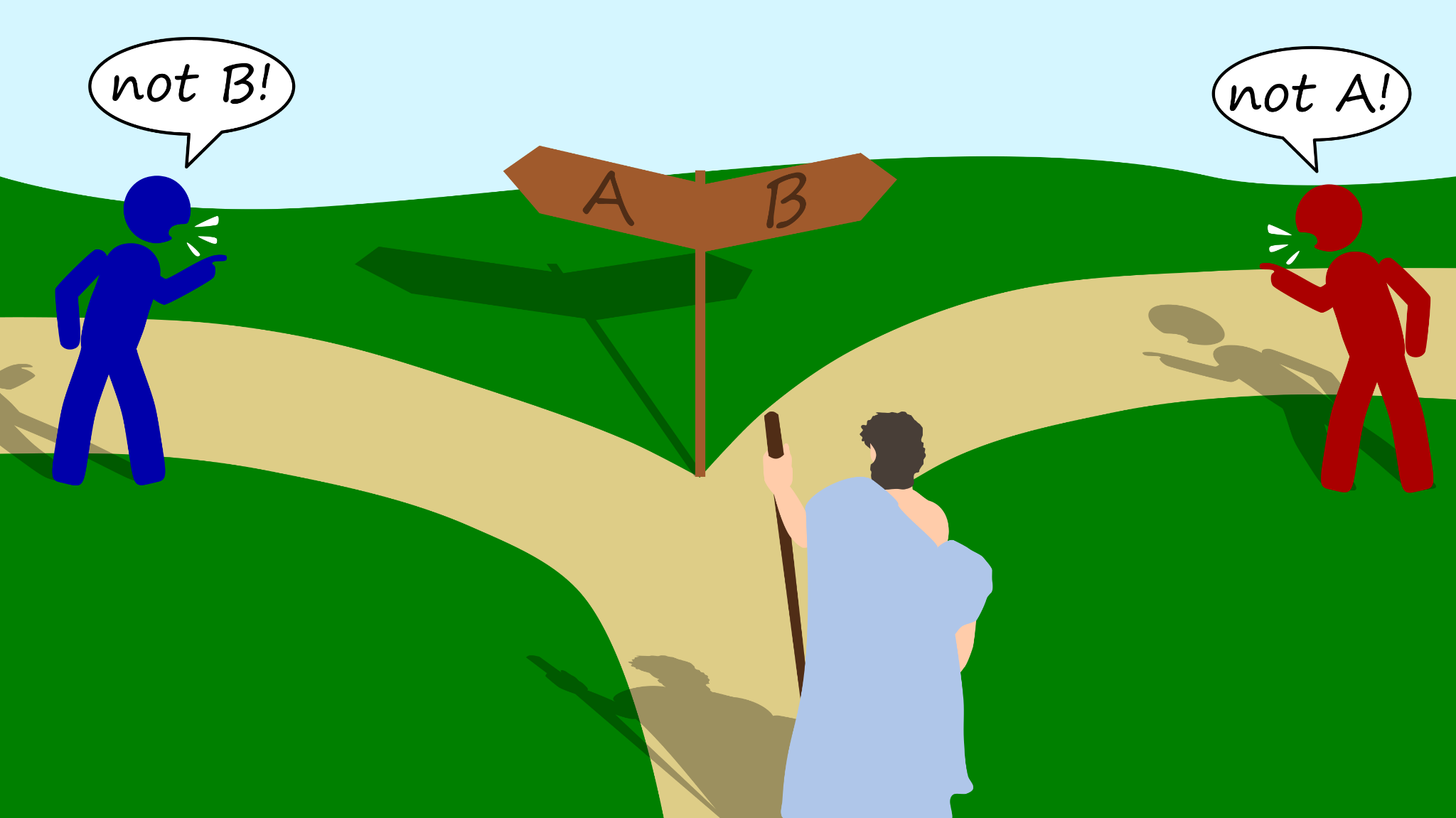
The argument seems forceful because it resembles an elementary logical inference. Yet its conclusion may tell us remarkably little about the proposal it is supposed to defend. To understand why, it helps to distinguish the validity of an inference from the justification of its premisses. This distinction will take us from an elementary rule of logic to L. E. J. Brouwer’s intuitionism and finally to political debate.
The parallel is not intended to make political judgement a branch of mathematics. Rather, we shall ask what happens when an affirmative conclusion is obtained by eliminating a rival, instead of providing evidence in favour of the conclusion itself.
Disjunction and modus tollendo ponens
Let \(A\) and \(B\) stand for any two propositions. The symbol \(\lor\) means “or”, in its inclusive sense: \(A\lor B\) asserts that at least one of \(A\) and \(B\) holds. The symbol \(\neg\) means “not”. The rule called modus tollendo ponens (MTP), also known as disjunctive syllogism, is \[\frac{A\lor B\qquad\neg A}{B}\qquad\mathrm{MTP}.\] If at least one of two propositions holds and the first does not, the second follows. The rule is valid in classical logic and in intuitionistic logic alike. But the conclusion is warranted only if both premisses are warranted.
This point becomes especially clear in natural deduction (ND), a method of representing proofs through rules for introducing and eliminating logical connectives. To introduce a disjunction, we may prove either side: \[\frac{A}{A\lor B}\;(\lor I_1) \qquad\qquad \frac{B}{A\lor B}\;(\lor I_2).\] To eliminate a disjunction, we must show that a desired conclusion \(C\) follows in either case: \[\frac{\begin{array}{c}{}\\{}\\ A\lor B\end{array}\qquad \begin{array}{c}[A]\\\vdots\\ C\end{array}\qquad \begin{array}{c}[B]\\\vdots\\ C\end{array}} {C}\;(\lor E).\] The square brackets indicate temporary assumptions: we reason separately from \(A\) and from \(B\), then discharge those assumptions. In particular, \(C\) can be \(B\). If we temporarily suppose \(A\), our premiss \(\neg A\) yields a contradiction, denoted by \(\bot\); by ex falso quodlibet (\(\bot E\)), any proposition follows from that contradiction. If we suppose \(B\), we already have the desired conclusion. Thus MTP is derivable using only intuitionistically acceptable rules:
The proof reveals the crucial question:
What entitles us to begin with \(A\lor B\)?
The rule of inference cannot supply that entitlement for us. For introductions to the proof rules and to the two treatments of disjunction, see [5, 6].
False dilemmata
A false dilemma is an argument that presents alternatives as exhaustive without sufficient grounds for doing so. The familiar form is \[A\lor B,\qquad\neg A,\qquad\therefore B.\] The application of MTP is flawless. What may be defective is the first premiss. The argument has not shown why at least one of its two alternatives must hold.
It is tempting to characterise every false dilemma as the omission of a third alternative. That is too narrow. The difficulty is not necessarily how many possibilities exist, but whether the stated disjunction is justified. Even when an issue genuinely concerns just two objects, it need not follow that at least one possesses the particular property being discussed. We may have only two candidates for an office, for example, without having any reason to believe that at least one is competent.
Nor must an unjustified disjunction be false. There is a difference between having grounds to refute a statement and lacking grounds to assert it. The distinction will matter in the mathematical case that follows: some disjunctions are not constructively established even though they cannot constructively be refuted.
Brouwer, intuitionism, and tertium non datur
What makes a proof constructive?
Early in the twentieth century, the Dutch mathematician Luitzen Egbertus Jan Brouwer (1881–1966) developed intuitionism, a philosophy of mathematics in which mathematical assertions are understood through the constructions that justify them. Brouwer’s criticism of the unrestricted law of excluded middle was expressed already in his 1908 essay on the unreliability of logical principles. Arend Heyting subsequently helped formulate the logical rules associated with this approach [1, 2].
One need not adopt Brouwer’s entire philosophy to appreciate the underlying proof-theoretic idea. Under the familiar Brouwer–Heyting–Kolmogorov (BHK) interpretation, a proof of \(A\land B\) supplies proofs of both propositions, while a proof of \(A\lor B\) supplies a proof of one disjunct, together with an indication of which one it is. A proof of \(\neg A\) gives a construction transforming a hypothetical proof of \(A\) into a contradiction. And a proof of \(\exists x\,P(x)\) supplies an object \(a\) for which \(P(a)\) can be established [6, 3].
A witness, in this setting, is such a positively supplied piece of evidence: for an existential statement it is the exhibited object; for a disjunction it is a proof of one side. This is the sense of constructive relevant to our argument. It is stronger than merely showing that a statement cannot be false.
Excluded middle and double negation
The classical principle tertium non datur (TND), or excluded middle, has the form \[A\lor\neg A.\] In classical logic it is a theorem for every proposition \(A\). Intuitionistic logic does not accept it as a theorem in general: to justify the disjunction constructively, we would need a proof of \(A\) or a proof that \(A\) leads to contradiction, and there is no universal procedure of this kind for arbitrary mathematical propositions. Particular instances are entirely legitimate when we can decide \(A\). For example, whether a given natural number is even is decidable, so the corresponding instance of TND has a constructive proof [5].
The issue is visible when MTP is applied to TND. If we also know \(\neg\neg A\)—that assuming \(\neg A\) yields a contradiction—we may exclude the second disjunct and derive \[\frac{A\lor\neg A\qquad\neg\neg A}{A}.\] This is duplex negatio affirmat (DNA), or double-negation elimination. It is accepted in classical logic but not generally derivable intuitionistically. For example, if \(A\) says that an object with property \(P\) exists, DNA would permit the passage \[\neg\neg\exists x\,P(x)\quad\Longrightarrow\quad\exists x\,P(x),\] without necessarily constructing an object \(a\) satisfying \(P(a)\) [3].
This does not mean that intuitionists prove TND false, or that intuitionistic logic requires a third truth value. Indeed, intuitionistic logic proves \[\neg\neg(A\lor\neg A).\] It means that TND lacks the constructive justification required for its unrestricted assertion. In this justificatory sense, some uses of TND can function as false dilemmata: one begins with a disjunction that has not been constructively warranted, excludes a disjunct, and obtains an affirmative conclusion through an otherwise valid application of MTP. The premiss has a different status from an empirically false dichotomy, but the argumentative structure is the same.
But where does the positive evidence come from?
We can now isolate the structural point without committing ourselves to any particular subject matter. Suppose our aim is not merely to deduce a sentence \(B\), but to obtain positive evidence for it. We start with \[A\lor B,\qquad\neg A,\] and invoke MTP. What information has the inference actually produced?
In a constructive setting, a proof of \(A\lor B\) already comes with a justified alternative. For pure intuitionistic propositional logic this is captured by the disjunction property: \[\text{if }\vdash_{\mathrm{Int}} A\lor B, \quad\text{then }\vdash_{\mathrm{Int}} A \quad\text{or }\vdash_{\mathrm{Int}} B.\] Here \(\vdash_{\mathrm{Int}} A\) means that \(A\) has a proof without undischarged assumptions. In a normalised closed proof, the evidence for the disjunction can be read as evidence for a particular disjunct. Given also \(\neg A\) and a consistent proof context, that disjunct must be \(B\) [5].
Thus, as a source of positive justification, MTP is in a sense avoidable: the constructive evidence establishing \(B\) is already recoverable from the justification of the original disjunction. MTP may be a convenient way to organise a derivation, or a useful computation for discovering which case we are in. And a disjunction introduced as an open assumption need not itself provide a known proof of either side. The claim is not that MTP is useless, nor that it is nonconstructive. It is that MTP cannot generate positive evidence which the constructive justification of its premisses did not already contain.
This explains a recurring rhetorical manoeuvre:
“This alternative is bad; therefore the other one is good.”
If the second alternative really is good, we still want to know why. A properly supported disjunction may already answer that question; an unsupported one cannot. Eliminating what is bad is not the same intellectual task asexhibiting what is good. The contrast is particularly useful in politics, where constructive argument often means propositive or proposal-oriented argument: a case made in favour of a positive project, rather than only against an opponent.
The political case: from opposition to proposal
Political competition often encourages parties to describe an election as a contest between two camps. Yet the problematic disjunction is not necessarily \[\text{``vote for }P\text{''}\ \lor\ \text{``vote for }Q\text{''.}\] It is instead a claim about the parties’ merits. Let \(G(P)\) mean that party \(P\) is good—for instance, that its programme deserves positive endorsement. The argument becomes \[\frac{G(P)\lor G(Q)\qquad\neg G(P)}{G(Q)}\qquad\mathrm{MTP}.\] In ordinary language: our opponents are bad; therefore we are good. The inference is valid, but its disjunctive premiss has not been established. It may be that \[\neg G(P)\land\neg G(Q).\] Even if \(P\) and \(Q\) are the only parties or candidates who can win, this possibility remains. Exhaustive electoral choices are not the same thing as exhaustive alternatives for political goodness. The failure of one programme is not yet a witness to the merits of another.
A more constructive—in the political sense, a more propositive—argument would tell us what the proposed programme contains, what problems it addresses, why its objectives are desirable, and how its measures could plausibly be realised. Criticising an opponent can be relevant to political judgement, but it cannot by itself supply those positive reasons.
There is an important distinction between goodness and comparative preference. Demonstrating that \(P\) is worse than \(Q\) may give a rational reason to vote for \(Q\), even if neither is good. That is a separate practical judgement, made after assessing the options available. Our objection is to the illicit promotion of a relative verdict—“\(Q\) is preferable to \(P\)”—into an absolute one—“\(Q\) is good”. Nor is negative campaigning inherently without informational value: it may expose relevant weaknesses or policy differences [4]. The fallacy arises when a party treats the demolition of an adversary as sufficient proof of its own virtues.
The mathematics suggests a useful demand on political rhetoric. If the intended conclusion is positive, the case for it must contain positive grounds somewhere. Where they are absent from the initial disjunction, they cannot suddenly appear merely because a rival has been refuted.
The constructive core
The mathematical and political cases share a simple argumentative pattern: a disjunction is introduced, one alternative is excluded, and the other follows by MTP: \[\underbrace{A\lor B}_{\text{disjunction to be justified}} \qquad\neg A \quad\overset{\mathrm{MTP}}{\Longrightarrow}\quad B.\] The crucial question comes before the inference:
What justifies \(A\lor B\)?
If we seek positive evidence for \(B\), this question becomes particularly important. In constructive reasoning, a justification of the disjunction already contains evidence for one of its disjuncts; MTP draws on that evidence rather than providing an independent source of it. In politics, the criticism of one party establishes the goodness of its rival only if the original claim that at least one of them is good has been justified.
Eliminating a bad alternative is not equivalent to positively justifying the remaining one. An affirmative conclusion calls for positive grounds. We should therefore examine the justification of the initial disjunction and ask where the evidence for the conclusion enters the argument. In politics, this means moving from opposition to proposal: a propositive argument explains what a programme offers, why its aims deserve support, and how it can be put into practice.
References
- van Atten, Mark. 2020. “Luitzen Egbertus Jan Brouwer.” In The Stanford Encyclopedia of Philosophy, Spring 2020 edition, edited by Edward N. Zalta. Metaphysics Research Lab, Stanford University. Online edition.
- van Atten, Mark. 2023. “The Development of Intuitionistic Logic.” In The Stanford Encyclopedia of Philosophy, Fall 2023 edition, edited by Edward N. Zalta and Uri Nodelman. Metaphysics Research Lab, Stanford University. Online edition.
- Bridges, Douglas, Erik Palmgren, and Hajime Ishihara. 2022. “Constructive Mathematics.” In The Stanford Encyclopedia of Philosophy, Fall 2022 edition, edited by Edward N. Zalta and Uri Nodelman. Metaphysics Research Lab, Stanford University. Online edition.
- Geer, John G. 2006. In Defense of Negativity: Attack Ads in Presidential Campaigns. Chicago: University of Chicago Press. DOI.
- Moschovakis, Joan. 2024. “Intuitionistic Logic.” In The Stanford Encyclopedia of Philosophy, Summer 2024 edition, edited by Edward N. Zalta and Uri Nodelman. Metaphysics Research Lab, Stanford University. Online edition.
- Troelstra, Anne S., and Dirk van Dalen. 1988. Constructivism in Mathematics: An Introduction. Vol. 1. Amsterdam: North-Holland.