
Coincidences often capture our attention and imagination. While the chance that two specific individuals share the same birthday is extremely low, considering larger groups dramatically increases the probability of at least one shared birthday. The Birthday Problem illustrates this counterintuitive principle: rare events become almost inevitable when opportunities accumulate. In this article, we explore the mathematical basis of this effect and discuss its implications for understanding why coincidences are far more common than intuition suggests.
Coincidences
We can define a coincidence as:
Definition (Coincidence): The occurrence of two events whose simultaneous verification has a very low probability.
In our everyday lives, coincidences seem to appear everywhere: meeting someone who shares our birthday, thinking of a friend just before they call, or discovering unexpected connections between strangers. These moments often feel surprising, even mysterious, and throughout history they have captured human imagination. Literature, folklore, and popular culture are full of stories where coincidences serve as plot devices, omens, or signs of destiny—from the seemingly chance encounters in Charles Dickens’ novels to the unlikely events in classic fairy tales.
For example, in detective fiction, characters like Jessica Fletcher [8] seem to encounter improbable crimes wherever they go—a running joke among viewers that plays on the human fascination with patterns and “coincidences.” According to a popular fan theory, Jessica Fletcher may have a dark secret: she is, in fact, the most prolific serial killer in history, which could potentially explain the extraordinary number of crimes she encounters [2]. While entertaining in fiction, this mirrors our real-life tendency to see extraordinary connections where probability alone could explain events.
Humans are naturally attuned to noticing coincidences, in part because they stand out against the backdrop of everyday routine. Psychologists and cognitive scientists have shown that our brains are wired to detect patterns even in random noise [9][1][13][7]. While this ability has evolutionary advantages, it also makes us prone to over-interpreting coincidences. This is why coincidences often feel meaningful. This perceptual bias also underlies many superstitions and, more controversially, conspiracy theories: when events that are unlikely nevertheless occur, some people conclude that there must be a hidden plan or overarching cause behind them.
To better understand what’s really going on, let us consider the well-known example of the Birthday Problem [5][3], a classic thought experiment in probability. This example illustrates how events that feel surprising at first can, upon closer inspection, be expected and explainable, highlighting the sometimes counterintuitive nature of probability.
The Birthday Problem
Suppose we pick a random person. For simplicity, we make a few standard assumptions:
Birthdays are uniformly distributed across the 365 days of the year.
We ignore February 29th; including it would have a negligible effect on the probabilities.
Birthdays are independent events between individuals.
Under these assumptions, the probability that a randomly chosen person shares your exact birthday is:
\[\begin{aligned} P(\text{the two of you share the birthday}) &= \frac{1}{365} \approx 0.0027 & (\text{or } 0.27\%). \end{aligned}\]
Clearly, finding someone else with the same birthday as you appears extremely unlikely.
Similarly, the probability that two specific people were both born on a given date is practically zero. In other words, when considering a single pair of individuals, shared birthdays are rare enough that encountering one feels like a genuine coincidence, which explains why such events are often perceived as surprising or remarkable in everyday life.
However, the situation changes dramatically when we consider a larger group and look for at least one other person that shares your birthday.
For example, imagine a typical high school class of 25 students. We can compute the probability that no one else in the class shares your birthday, and consequently the probability that at least one student does:
\[\begin{aligned} P(\text{no one shares your birthday}) &= \left( \frac{364}{365} \right)^{24} \approx 0.9363 & (\text{or } 93.63\%),\\ P(\text{at least one shares your birthday}) &= 1 - 0.9363 \approx 0.0637 & (\text{or } 6.37\%). \end{aligned}\]
This means that in a class of 25 students, there is still only a small chance—about 6 out of 100—that someone shares your birthday. While 6.37% is certainly not high, it is not negligible either: it corresponds roughly to 1 case out of 16, which could happen surprisingly often if you consider multiple classes or repeated situations over time. In other words, while sharing your birthday with a classmate remains unlikely, it is far from impossible, highlighting how our intuition often underestimates the frequency of such coincidences in small groups.
We can extend the problem further by asking a slightly different question: what is the probability that any two people in a group share a birthday? In other words, we no longer focus on a specific individual, but on any coincidence among the group.
For example, consider again a typical high school class of 25 students. The probability calculations are:
\[\begin{aligned} P(\text{no shared birthday among 25 people}) &= \frac{365}{365} \cdot \frac{364}{365} \cdots \frac{341}{365} \approx 0.4313 & (\text{or } 43.13\%),\\ P(\text{at least one shared birthday}) &= 1 - 0.4313 \approx 0.5687 & (\text{or } 56.87\%). \end{aligned}\]
Notice that the probability of at least one shared birthday has now risen above 50%! In practical terms, this means that in a class of 25 students, it is more likely than not that at least two students share a birthday. Intuition often fails here: while any specific match is unlikely, the sheer number of possible pairs in the group makes a coincidence quite probable. This simple observation illustrates why “surprising” coincidences are much more common in groups than our everyday intuition suggests.
Now, let us scale up the situation and imagine a school with 40 classes, each containing 25 students. The probability that a single class has no shared birthdays is about 43.13%. Therefore, the probability that none of the 40 classes contain a birthday match is: \[(0.4313)^{40} \approx \text{a vanishingly small number}.\]
Consequently, the probability that at least one class has a birthday match is essentially:
\[1 - (0.4313)^{40} \approx 1 \ (\text{or nearly} 100\%).\]
In other words, in a school of 40 classes, it is virtually certain that at least one class contains at least two students who share a birthday.
Even if we reduce the number of classes to 10, the probability of at least one birthday match remains extremely high—around 99.98%. This shows how dramatically the likelihood of coincidences grows as we increase the number of groups, even when each group is relatively small. Intuition often underestimates this effect: while a shared birthday in a single class is not guaranteed, having many classes almost guarantees that a coincidence will occur somewhere.
| Situation | Probability |
|---|---|
| A random person shares your birthday | 0.27% |
| At least one person (out of 25) shares your birthday | 6.37% |
| At least two people (out of 25) share a birthday | 56.87% |
| In 40 groups of 25, at least one group has a birthday pair | \(\sim\)100% |
In all of the calculations above, we have assumed that birthdays are independent and identically distributed (i.i.d.), meaning each birthday is equally likely and independent of others. In reality, however:
Birthdays are not perfectly uniform across the year—for instance, more births tend to occur in certain months.
Births are not entirely independent; twins or multiple births naturally share the same birthday.
Cultural or scheduling patterns, such as avoiding holidays or choosing certain dates, can create clusters of birthdays.
Accounting for these real-world effects actually increases the probability of shared birthdays compared to our idealised calculations. In other words, coincidences of this type are often even more likely than the simple model suggests.
The purpose of the birthday problem example, however, is not to provide an exact description of reality but rather to illustrate a deeper point: even in a simplified and perfectly uniform model, the probability of a “surprising” coincidence grows much faster than our intuition usually expects. What at first appears nearly impossible (two people sharing a birthday) becomes rather likely as soon as we enlarge the group, or relax the question to ask whether *any* coincidence of that type occurs.
The Simpsons predicted it!
Accounting for these real-world effects actually increases the probability of shared birthdays compared to our idealised calculations. In other words, coincidences of this type are often even more likely than the simple model suggests.
Moreover, the birthday problem is just a toy model: in real life there are many additional factors that make coincidences even more common. One important factor is time. While a single day might pass without anything noteworthy, over weeks, months, or years the opportunities for coincidences accumulate. It is like extending the birthday problem from one classroom to an entire school: if you consider many groups over many days, the chance of at least one surprising overlap quickly approaches certainty.
A cultural illustration of this is the phenomenon often described as “The Simpsons predicted it!” [6]. With more than 36 seasons and 790 episodes (plus a feature film and numerous shorts), the show has generated such a vast number of scenarios, jokes, and satirical storylines that some of them are bound, by sheer probability, to resemble later real-world events. In other words, given enough trials, coincidences are inevitable—and our perception turns them into “predictions.”
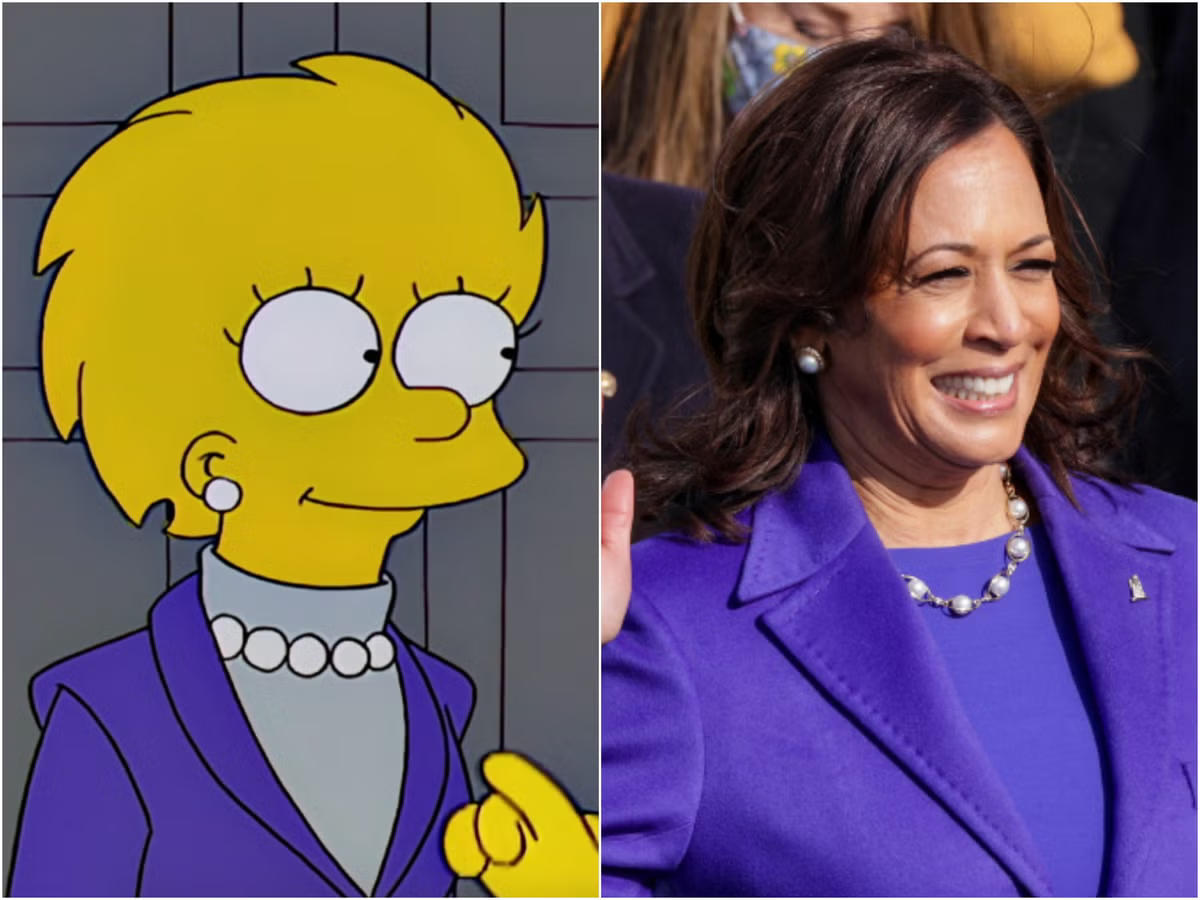
Another factor is human agency. Sometimes coincidences are not purely random but are subtly engineered. A well-known example occurred during the 2021 U.S. presidential inauguration, when Kamala Harris wore an outfit resembling Lisa Simpson’s presidential attire in the 2000 episode Bart to the Future [11]. Many people presented this as another case of “The Simpsons predicted it!”, but it is far more plausible that Harris (or her team) intentionally chose the outfit to evoke the reference [12].
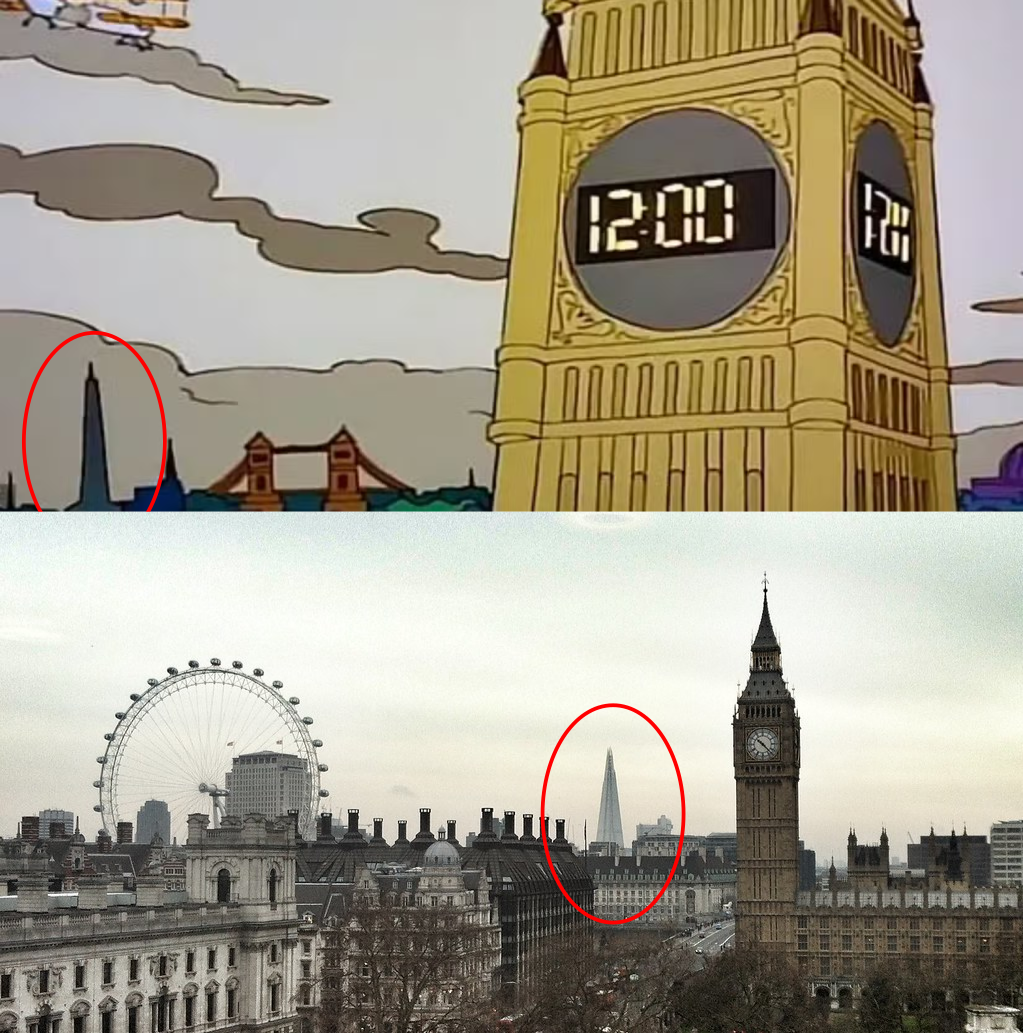
Finally, there are coincidences that exist only in our perception. Our brains are tuned to recognise patterns, and we often consider things “close enough” to count as a coincidence. Take, for example, the 1995 episode Lisa’s Wedding [10], which shows a futuristic London skyline. 1 Behind Tower Bridge appears a pointy skyscraper remarkably similar to what we now know as The Shard. At the time, the building did not even exist—construction began only in 2009—yet fans today retroactively interpret the sketch as an “uncanny prediction.” More likely, it was simply an artist’s generic skyline drawing, later reinterpreted as meaningful once the real Shard appeared [4]. Such reinterpretations highlight how much coincidences depend on our tendency to simplify and impose order on randomness.
Understanding coincidences
The birthday problem serves as a simple but powerful illustration of how coincidences arise. When we stop focusing on one very specific outcome and instead consider the wider set of possibilities, the chance of encountering at least one coincidence increases dramatically. But as we have seen, real life makes the situation even richer. Over time, the accumulation of opportunities makes coincidences almost inevitable, human choices can deliberately manufacture or amplify them, and sometimes we ourselves “create” coincidences by retrospectively interpreting vague similarities.
All of these cases show that coincidences need not be mysterious or supernatural or the effect of a conspiracy. While a very specific coincidence may be highly improbable, the probability that some coincidence of the same kind occurs is overwhelmingly likely once we take into account the number of people, events, and interpretations available.
In short: Specific matches are rare, but some match is nearly inevitable. That is why coincidences feel so common in our everyday lives—they are a natural product of probability, human behaviour, and our own pattern-seeking minds, rather than signs of hidden forces at work.
References
- P. Brugger. From haunted brain to haunted science: A cognitive neuroscience view of paranormal and pseudoscientific thought. In J. Houran and R. Lange (eds.), Hauntings and Poltergeists: Multidisciplinary Perspectives, pp. 195–213. McFarland, 2001.
- M. Beattie, “‘She Did It: She Killed Them All!’ Murder, She Wrote,” June 23, 2023.
https://cstonline.net/she-did-it-she-killed-them-all-murder-she-wrote-by-melissa-beattie/. - P. Diaconis and F. Mosteller. Methods for studying coincidences. Journal of the American Statistical Association, 84(408):853–861, 1989.
- L. Farley, “This ‘Simpsons’ Episode Was a Turning Point for the Show in More Ways Than One,” Collider, January 27, 2025. https://collider.com/the-simpsons-lisas-wedding/.
- W. Feller. An Introduction to Probability Theory and Its Applications, Vol. 1. Wiley, 3rd edition, 1968.
- S. Garvan, “The Simpsons: How the show’s writers predict the future,” BBC News, July 19, 2019. https://www.bbc.com/news/newsbeat-49031845.
- D. Hoffman. . W. W. Norton & Company, 2019.
- Murder, She Wrote. CBS Television, 1984–1996.
- M. Shermer. Patternicity: Finding meaningful patterns in meaningless noise. Scientific American, December 2008.
- The Simpsons, “Lisa’s Wedding,” Season 6, Episode 19, aired March 19, 1995.
- The Simpsons, “Bart to the Future,” Season 11, Episode 17, aired March 19, 2000.
- A. White, “Simpsons fans believe Lisa’s presidential outfit ‘predicted’ Kamala Harris’s inauguration ensemble,” The Independent, January 21, 2021. https://www.independent.co.uk/arts-entertainment/tv/news/simpsons-predictions-kamala-harris-b1790490.html.
- J. A. Whitson and A. D. Galinsky. Lacking control increases illusory pattern perception. Science, 322(5898):115–117, 2008.
The careful reader may have noticed that both episodes mentioned, Bart to the Future and Lisa’s Wedding, are set in the future and originally aired on March 19. This is a remarkable coincidence!↩︎